
What is the verdict?
67/100. Selective Positive. A category-creating cash engine, priced at half its historical multiple because its two growth engines stalled in the same year its guidance credibility broke.
| 67/100 | DalalBytes score |
| $44.51 | Reference price, Oct 21, 2026 close |
| ~$64.5B | Market cap, 1,449.2M shares |
| $41 / $65 / $87 | FY2029 bear / base / bull |
Boston Scientific ended 2025 as the market's favorite large-cap medtech compounder: $20.07B of net sales, up 18% reported and 15.8% organic, an adjusted operating margin of 28.0%, free cash flow of $3,658M converting at 80%, and a long-range plan beaten a year early. The stock closed 2025 at $95.35 and had printed an all-time intraday high of $109.50 in September 2025.
Ten months later the stock trades at $44.51, with an early-October low of $41.38. The trailing GAAP P/E is about 18x against a five-year average above 50x. Forward multiples are about 13.6x FY2026E and 13.2x FY2027E adjusted EPS, EV/S is about 3.7x, and the free cash flow yield is about 5.6%. Nothing in the market broke: the S&P 500 is up 14.0% year to date and healthcare (XLV) is up 15.6%. This decline, 52.2% year to date, is entirely idiosyncratic.
What broke is specific. Electrophysiology (EP), the fastest-growing business in the company, met two well-armed rivals and saw its US pulsed-field ablation (PFA) spend share fall from 100% to about 41%. Watchman, the second engine, ran into trial evidence that slowed referrals and a mix shift management did not model. Management cut FY2026 adjusted EPS guidance twice (from $3.43-3.49 in February to $3.28-3.32 in July), then in September said even the cut numbers were unlikely to be met after an August cyberattack disrupted global manufacturing and ordering. In January, at the top of the market, management also agreed to buy Penumbra for about $14.5B, mostly with debt.
Our read: the damage is concentrated in guidance credibility and share defense in two categories, not in the cash engine. The businesses that produce the cash (the other six units, margins, conversion) are performing close to plan. The question the price now asks is whether the two stalled engines restart by 2028, which is management's own recovery framing. At 13x forward earnings with a 5.6% FCF yield, the market is pricing the air pocket as permanent. We think it is a two-year hole, not a terminal one. That is a Selective Positive, sized by the October 28 print, when management has promised updated FY2026 guidance.
Deliberately pre-print
Q3 2026 earnings arrive Wednesday, October 28, 2026, before the open (company-confirmed), with updated FY2026 guidance promised at the print. This report is written against the last confirmed numbers, H1 2026 and the September 8 guidance warning, and grades the setup going into the print rather than reacting to it.
What does Boston Scientific do?
Boston Scientific is a diversified medical device company headquartered in Marlborough, Massachusetts, selling into hospitals and clinics in more than 100 countries. Since a Q4 2025 recast it reports two segments, MedSurg and Cardiovascular, across eight business units. The US produced 64% of FY2025 sales.
| Segment | Unit | FY2025 net sales ($M) | What it does |
|---|---|---|---|
| MedSurg | Endoscopy | 2,916 | GI and pulmonary endoscopy devices |
| MedSurg | Urology | 2,709 | Urology and pelvic health, incl. Axonics neuromodulation for bladder |
| MedSurg | Neuromodulation | 1,199 | Spinal cord stimulation, deep brain, Intracept for back pain |
| Cardiovascular | Interventional Cardiology Therapies (ICVT) | 4,639 | Coronary and structural intervention, drug-coated balloons, IVL |
| Cardiovascular | Electrophysiology (EP) | 3,325 | FARAPULSE PFA ablation for atrial fibrillation |
| Cardiovascular | Cardiac Rhythm Management (CRM) | 2,332 | Pacemakers, defibrillators, diagnostics (LUX-Dx) |
| Cardiovascular | Watchman | 1,958 | Left atrial appendage closure (LAAC) for stroke prevention |
| Cardiovascular | Interventional Oncology and Embolization (IO&E) | 996 | Cancer and embolization therapies |
Two units dominate the investment debate. EP, built on the FARAPULSE pulsed-field ablation system, went from about $0.8B in 2023 to $3,325M in FY2025 and made Boston Scientific the defining company of the PFA era. Watchman, the only scaled LAAC device in the US, reached $1,958M in FY2025 with roughly 90% category share. Together they are 26% of sales and were expected to supply most of the company's growth algorithm. The other six units are slower, steadier, and currently carrying the P&L.
The strategic identity is category creation. FARAPULSE created the PFA category in ablation; Watchman created LAAC as a device alternative to blood thinners; the AGENT drug-coated balloon created a US coronary DCB market in 2024. The five-pillar question is whether category creation still compounds when the categories get contested, and whether the balance sheet can fund the next creation (Penumbra's thrombectomy) while the current two are defended.
What went wrong in 2026?
No single event halved this stock. It was a sequence: a deal at the peak, then two guidance cuts, then a cyberattack that forced guidance withdrawal, against two competitive share fights and a steady drumbeat of Class I recalls. The chronology is the report in miniature.
| Date (2026) | Event |
|---|---|
| Jan 15 | Penumbra acquisition announced: $374 per share, about $14.5B enterprise value, about 73% cash, 27% stock |
| Feb 4 | Initial FY2026 guidance: reported growth 10.5-11.5%, organic 10-11%, adjusted EPS $3.43-3.49 |
| Mar 5 | Securities class action filed (Troike v. Boston Scientific) |
| Mar 16 | FTC Second Request on the Penumbra deal |
| Apr 22 | First cut: adjusted EPS guidance lowered to $3.34-3.41; Watchman 2026 growth expectation reduced from mid-teens |
| May 18 | $2B accelerated share repurchase launched (completed in Q2); $1.5B MiRus TAVR investment announced the same day |
| Jul 29 | Second cut: adjusted EPS $3.28-3.32; restructuring plan announced ($700-800M pre-tax charges, about $500M run-rate savings exiting 2029, over half by end-2027); Watchman FY2026 cut to flat to low-single-digit growth; CEO admits the US EP competitive share call was undercalled |
| Aug 25-26 | Cyberattack detected; 8-K filed August 26 disclosing disruption to global manufacturing and order processing |
| Sep 8 | 8-K: Q3 and FY2026 guidance "unlikely" to be met; updated guidance promised with Q3 results |
| During 2026 | Three Class I recalls (AXIOS delivery system February, Infinion CX leads September, Imager II catheters September), on top of the 2025 ACCOLADE and ENDOTAK actions |
| Oct 28 (ahead) | Q3 2026 earnings before the open, with updated FY2026 guidance |
Read the sequence the way the market did. The February guidance was set with full knowledge of the Medtronic and Abbott PFA launches, yet EP share still surprised management by July. The Watchman slowdown was visible in the evidence base (CLOSURE-AF had failed its endpoint in November 2025) yet the April guide still assumed mid-teens growth. The cyberattack was unforeseeable in timing but hit a company whose order systems turned out to be a single point of failure across global manufacturing. Each event alone is survivable. Together they converted a premium compounder multiple into a show-me multiple, which is what 13x forward earnings is.
The credibility gap is the valuation gap
Management beat its 2023 long-range plan early (Section 10), then cut 2026 guidance twice and withdrew it within seven months. Until guidance is reinstated on October 28 and then met, the burden of proof sits with the company, and the multiple will price that burden first and the recovery second.
What does the financial record show?
Four years of financials show a company that scaled revenue at a mid-teens organic rate while expanding margins and nearly quadrupling free cash flow. This is the engine the verdict refers to. It is also the record that makes 2026 read as an interruption rather than a new trend, so far.
| $M except per share | FY2022 | FY2023 | FY2024 | FY2025 |
|---|---|---|---|---|
| Net sales | 12,682 | 14,240 | 16,747 | 20,074 |
| Organic growth | n/d | +12.3% | +16.4% | +15.8% |
| GAAP gross margin | 68.4% | 69.2% | 68.6% | 69.0% |
| Adjusted operating margin | n/d | n/d | 27.0% | 28.0% |
| GAAP net income | 642 | 1,570 | 1,853 | 2,898 |
| GAAP EPS | $0.45 | $1.07 | $1.25 | $1.94 |
| Adjusted EPS | $1.71 | $2.05 | $2.51 | $3.06 |
| Operating cash flow | 1,526 | 2,503 | 3,435 | 4,534 |
| Free cash flow | 938 | 1,792 | 2,645 | 3,658 |
| FCF conversion of adjusted net income | n/d | n/d | 71% | 80% |
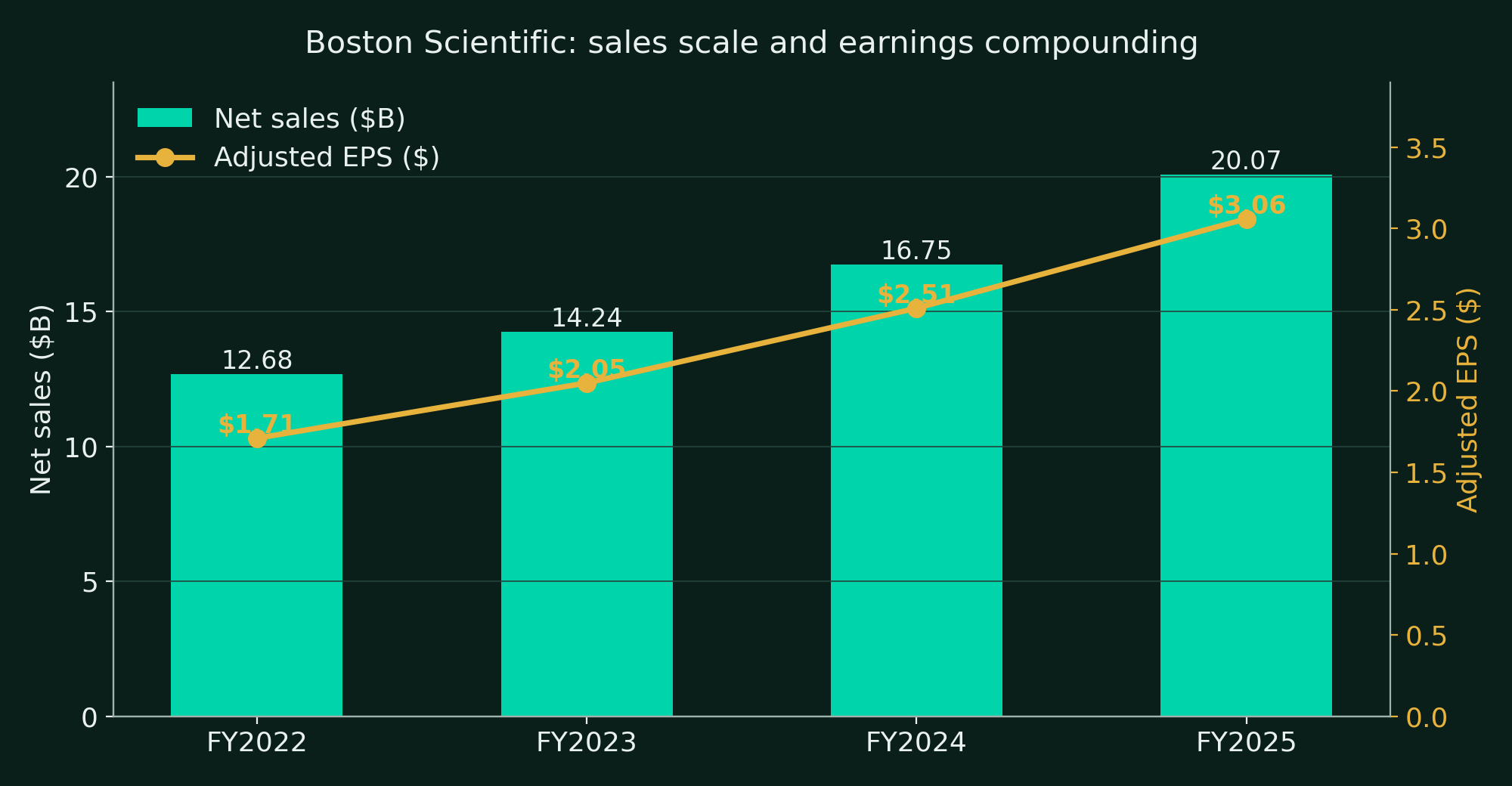
Adjusted EPS grew 22% in both FY2024 and FY2025. Free cash flow conversion of 80% in FY2025 beat the long-range plan target of about 70% by a wide margin, and it was achieved while absorbing acquisition integration and a tariff headwind of about $100M in FY2025 (revised down from an original estimate of about $200M).
H1 2026 kept the revenue line moving (net sales of $10,646M) with adjusted EPS of $1.66 and free cash flow of $1,450M, seasonally the lighter half. Management guided FY2026 free cash flow of about $3.8B on the Q2 call, before the cyberattack warning. Two GAAP items flatter the reported H1 numbers and are excluded from adjusted results: a deferred tax benefit of about $250M in Q1 2026, and an $83M IEEPA tariff refund booked in Q2 2026 cost of sales as tariff law reversed. Neither is a reason to distrust the adjusted series, but both are reminders that GAAP EPS in 2026 is not the clean read; adjusted EPS and cash flow are.
The weak spot inside the record is GAAP gross margin, stuck at 68.6-69.2% for four years despite mix shifting toward high-value EP and Watchman systems. The adjusted operating margin did the expanding instead (27.0% to 28.0%), powered by operating leverage and portfolio pruning. The July 2026 restructuring plan ($700-800M of pre-tax charges for about $500M of run-rate savings exiting 2029, over half by end-2027) is management's attempt to restart that leverage. Whether it is genuine productivity or a margin bridge built to cover a growth shortfall is a 2027 evidence question.
How do the segments break down?
The Q4 2025 recast makes FY2025 the first clean year under the two-segment structure. MedSurg contributed $6,824M and Cardiovascular $13,250M. Q2 2026 segment operating margins (segment basis) were MedSurg 32.9%, down from 35.1%, and Cardiovascular 33.1%, a mix effect as EP and Watchman slowed while lower-margin units held up.
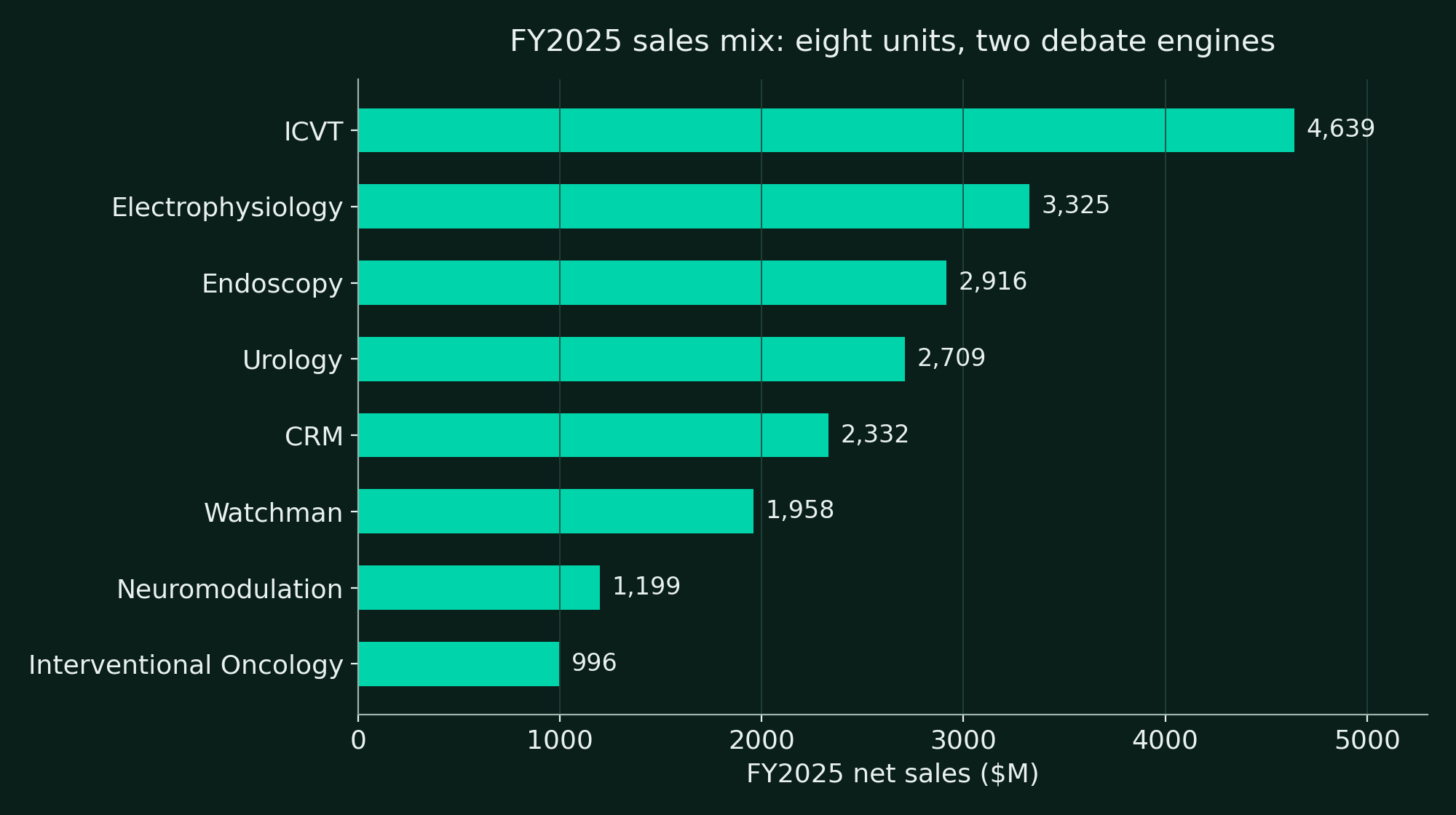
| Unit | FY2025 ($M) | Q2 2026 growth | Read |
|---|---|---|---|
| ICVT | 4,639 | +13.2% reported | AGENT DCB and SEISMIQ IVL pipeline carrying growth |
| Electrophysiology | 3,325 | +9.0% reported | Decelerating from +73% in FY2025 (Section 6) |
| Endoscopy | 2,916 | +7.0% organic | Steady mid-single-digit category, executing |
| Urology | 2,709 | +0.8% organic | Axonics integration and SNM recovery slower than planned |
| CRM | 2,332 | -0.8% reported | The weak flank: recalls, no leadless answer (Section 9) |
| Watchman | 1,958 | +4.3% reported | From +29% organic in FY2025 to low-single-digit (Section 7) |
| Neuromodulation | 1,199 | +12.2% organic | SCS recovery plus Intracept and Nalu |
| Interventional Oncology | 996 | +12.7% reported | Small, fast, under-discussed |
Geography is US-heavy by design: FY2025 net sales were US $12,864M, EMEA $3,451M, APAC $3,080M, LACA $678M, with Emerging Markets at $2,985M inside those regions. China is not separately disclosed. The company has never quantified its China volume-based procurement exposure; in Q2 2026 China grew double digits within APAC. The absence of a China line is a disclosure gap investors should keep on the risk list (Section 18), not a number anyone should estimate on the company's behalf.
Is FARAPULSE losing the PFA share war?
Boston Scientific created the pulsed-field ablation category. FARAPULSE won a CE mark in 2021 and FDA approval on January 31, 2024; it passed $1B of revenue in 2024, 200,000 patients by February 2025, and 500,000 cases by September 30, 2025. EP sales went from about $1.9B in FY2024 (+139%) to $3,325M in FY2025 (+73%). Then the category filled in behind it, and growth stepped down quarter by quarter.
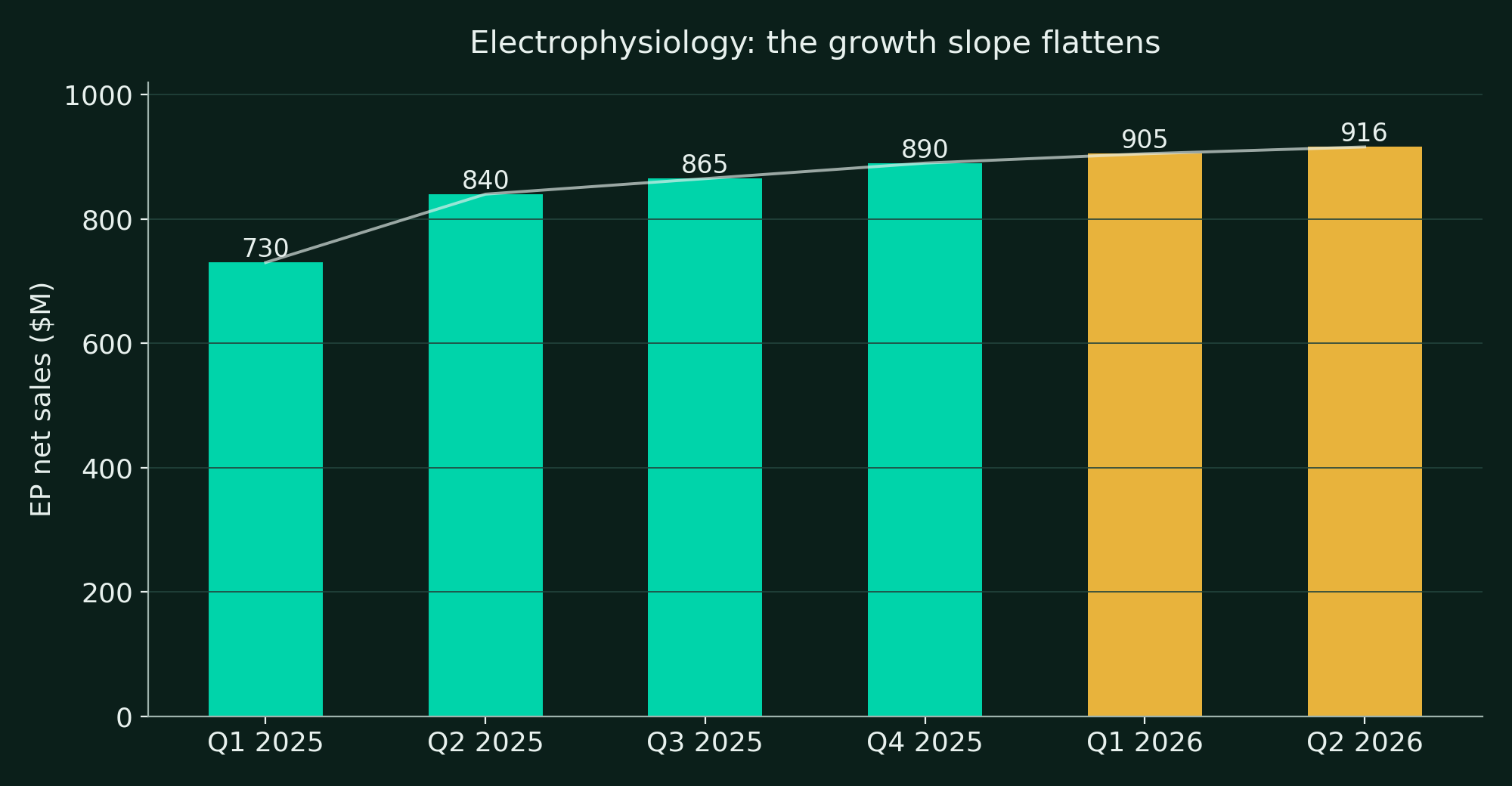
The share math is the center of the bear case. Qsight purchasing data across more than 4,500 US facilities puts Boston Scientific's share of US PFA catheter spend at 100% in 2023 (a monopoly) and about 41% by early 2026. The company frames its share at about 50%. Either way, half or more of a monopoly is gone in two years, and on the July 29, 2026 call CEO Mike Mahoney said it plainly: "we did undercall the competitive pressures in the U.S."
| Rival PFA system | Company | Status at October 2026 |
|---|---|---|
| PulseSelect | Medtronic | First FDA-approved PFA system (Dec 2023) |
| Affera / Sphere-9 | Medtronic | FDA approved Oct 24, 2024; CAS revenue crossed $2B TTM ahead of schedule; Q1 FY27 CAS +88% worldwide, +139% US |
| Sphere-360 | Medtronic | Coming; aimed at the single-shot lane FARAPULSE owns |
| Volt | Abbott | FDA approved Dec 22, 2025; Volt 2.0 full US release in Q3 2026 |
| TactiFlex Duo | Abbott | FDA approved Sep 2026 (focal ablation) |
| VARIPULSE | Johnson and Johnson (Biosense Webster) | FDA approved Nov 2024; January 2025 US safety pause after 4 neurovascular events in about 130 evaluation cases (no deaths); relaunched Feb 2025; Varipulse Pro in a head-to-head trial against FARAPULSE |
Context matters more than the roster. PFA is already 78% of US AFib ablation catheter spend (Qsight, early 2026): the technology transition is nearly complete, so the fight is now over share of a converting market, not over conversion. Boston Scientific frames the EP market growing from about $13B in 2025 to about $20B in 2028. A 41-50% share of a $20B market is a larger business than a monopoly of the 2025 market, which is the bull framing. The bear framing is that share is still falling, pricing follows share, and Medtronic's Sphere-360 attacks the single-shot procedure that is FARAPULSE's reason to exist.
The pipeline answers are real but uneven. The persistent-AF label arrived on time (FDA, July 7, 2025). FARAPOINT focal ablation was approved in January 2026, weeks later than the year-end 2025 guidance. FARAFLEX, the focal platform meant to answer Abbott and Medtronic in focal procedures, is still investigational. FARAWAVE Ultra is expected in H2 2027. None of these is a 2026 fix. EP stabilization in the 40s share range, with market growth doing the rest, is the base case this report underwrites (Section 16).
We did undercall the competitive pressures in the U.S.
Mike Mahoney, CEO, Q2 2026 earnings call, July 29, 2026
Is WATCHMAN still a growth engine?
Watchman is the purest moat story in the portfolio and, in 2026, its growth engine stalled. FY2025 sales were $1,958M, up 29% organic, with more than 600,000 patients treated cumulatively and roughly 90% share of a category Abbott's CEO sizes at about $2B. Then 2026 delivered $506M in Q1 and $507M in Q2 (up only 4.3% reported, US growth about 3%).
The mix shift explains the shape. About one-third of US procedures are now concomitant with an ablation, a cohort that grew more than 60% year over year in Q2 2026. The standalone two-thirds fell by low-teens percentages, and standalone procedures are where referrals originate. Management's explanation, given on the July cut, is an evidence-driven referral slowdown plus operational inefficiency in concomitant scheduling. Guidance followed the procedures down: from mid-teens 2026 growth expected in April to flat to low-single-digit for FY2026 in July, with H2 2026 US procedures expected to decline mid- to high-single digits and no Watchman growth assumed for 2027.
The evidence turn is genuinely two-sided, and the report scores it that way:
| Trial / analysis | Result | Read |
|---|---|---|
| OPTION (post-ablation) | Label expansion delivered July 2025 | Commercial win, expands the concomitant pool |
| CHAMPION-AF (n=3,000; ACC Mar 28, 2026; NEJM) | Safety superiority (non-procedural bleeding 10.9% vs 19.0%, HR 0.55); efficacy non-inferior (5.7% vs 4.8%, HR 1.20); net clinical benefit 15.1% vs 21.8%; ischemic stroke numerically higher with the device (3.2% vs 2.0%, HR 1.61 per trial reporting) | Best-case label data with a stroke asterisk the skeptics quote |
| CLOSURE-AF (Nov 2025) | Failed non-inferiority versus DOACs (adjusted HR 1.28) | The trial that started the referral slowdown |
| Meta-analysis (Sep 2026; 8 trials, 7,434 patients) | Ischemic stroke IRR 1.34 with LAAC; major bleeding IRR 0.73 | The trade LAAC offers, quantified: fewer bleeds, more ischemic events |
The prize is large if the label moves. About 5M patients sit in the currently indicated population, and company executives have said the indicated population could expand toward 20M by 2030 if CHAMPION supports a first-line label. That CHAMPION-based first-line label is NOT approved as of October 21, 2026, and the report treats it as an option, not a plan. Against the option stands a dated threat: Abbott's Amulet 360 won a CE Mark in August 2026 and completed its FDA submission in May 2026, the 2027 share threat management flagged without naming it. A 90% share franchise can only lose points; the question is whether the category grows fast enough, post-label, to outrun the sharing.
What about the rest of the portfolio?
Six units outside the EP and Watchman debate produced $14.8B of FY2025 sales and most of the cash. Their collective performance in 2026 is the reason this report can call the engine intact.
ICVT ($4,639M) is the largest unit and currently the most reliable grower, up 13.2% reported in Q2 2026. AGENT, the first US coronary drug-coated balloon (FDA March 1, 2024, for in-stent restenosis), created its category; the first rival, Cordis's SELUTION SLR, was only approved on September 21, 2026. The SEISMIQ intravascular lithotripsy system from the Bolt Medical acquisition met all endpoints in the FRACTURE trial in May 2026, with a coronary launch planned for H1 2027.
Neuromodulation ($1,199M) grew 12.2% organic in Q2 2026, the portfolio's quiet outperformer, on spinal cord stimulation recovery, the Intracept procedure for vertebrogenic back pain (from the Relievant acquisition), and Nalu Medical (closed January 27, 2026, for about $533M upfront, with over $60M of expected 2025 sales), which adds peripheral nerve stimulation.
Endoscopy ($2,916M) grew 7.7% organic in FY2025 and 7.0% organic in Q2 2026, in a market of about $8B growing about 6%. It is the portfolio's metronome: no single product drama, broad share, steady compounding.
Interventional Oncology and Embolization ($996M) grew 12% organic in FY2025 and 12.7% reported in Q2 2026, the smallest unit and one of the fastest, and the natural home for Penumbra-adjacent embolization thinking after the deal closes.
Urology ($2,709M) is the supporting cast's problem child. FY2025 organic growth was only 4.7% despite Axonics contributing 17.9 inorganic points, and Q2 2026 organic growth was 0.8%. Sacral neuromodulation recovery after the Axonics acquisition (closed November 15, 2024, at a $3.7B equity value; Axonics had $366M of 2023 revenue) is slower than planned, and FY2026 guidance was cut to flat to low-single-digit. The Medtronic patent war over SNM was settled in February 2025 with a confidential payment by Boston Scientific. A $3.7B acquisition growing at 0.8% organically is a capital allocation question the leadership section (Section 14) does not get to skip.
How weak is CRM?
Cardiac Rhythm Management is where Boston Scientific is losing on product, on quality, and on the calendar at the same time. FY2025 sales were $2,332M, up only about 1% organically, and Q1 2026 sales fell 3%, with low-voltage devices down low-teens. Q2 2026 was down 0.8% reported.
The quality file is heavy. The ACCOLADE pacemaker family carries a battery defect in pre-September 2018 builds: FDA Class I in February 2025 with 832 injuries and 2 deaths reported, expanded in May 2026 (reported figures in the expansion coverage cite 2,557 serious injuries and 4 deaths; treat those counts as reported, not filing-verified). The fix is a software correction (Brady SMR6), not a removal, and the matter cost about $75M of product-liability charge in Q2 2026 GAAP results. Separately, the ENDOTAK RELIANCE defibrillation leads are Class I (September 2025), with 386 serious injuries and 16 deaths reported as of July 24, 2025, across about 354,000 active leads; the management posture is monitoring, not explant.
The product gap is leadless pacing. Medtronic's and Abbott's leadless systems are in the market now; Abbott's Aveir DR dual-chamber system has been approved since July 2023. Boston Scientific's EMPOWER modular leadless system met its MODULAR ATP endpoints in May 2024, was submitted to the FDA in 2024, was expected to be approved in 2025, and has not been approved as of October 2026. That is a missed dated promise sitting inside the weakest unit. The next platform, PRECEDENT defibrillation, is not launching until H2 2027. Medtronic's CRM business, over $5.5B, grew 15% worldwide in Q1 FY27 with share gains: the share Boston Scientific is not taking.
The offset inside CRM is diagnostics. LUX-Dx insertable cardiac monitors grew low-double digits in Q1 2026 and are the unit's growth piece, but the company does not disclose LUX-Dx dollars, so the offset cannot be sized from filings. Net: CRM is a 12% of sales unit shrinking in share terms, carrying two of the company's most serious recalls, with its corrective products dated 2027. It is the clearest structural (not cyclical) problem in the portfolio.
Has management delivered on its roadmap?
Two long-range plans frame the credibility question. The 2023 Investor Day plan for 2024-2026 was beaten early and well. The September 30, 2025 plan for 2026-2028 was reaffirmed in February 2026 and then quietly abandoned in cadence: after the April and July cuts it has not been reaffirmed, and its 2026 leg is arithmetically broken.
| 2023 LRP commitment (2024-2026) | Delivered | Score |
|---|---|---|
| Organic revenue CAGR of 8-10% | +16.4% (FY2024), +15.8% (FY2025); even with the cut 2026 guide the three-year compound is about 12.4% | BEATEN |
| Adjusted operating margin up about 150bp to about 28% | 27.0% (FY2024), 28.0% (FY2025) | BEATEN EARLY |
| Double-digit adjusted EPS growth every year | +22% (FY2024), +22% (FY2025); FY2026 guided +7-8% after cuts | BEATEN, THEN MISSED (2026) |
| FCF conversion of about 70% by 2026 | 71% (FY2024), 80% (FY2025) | BEATEN |
| Sep 2025 LRP commitment (2026-2028) | Status at Oct 2026 | Score |
|---|---|---|
| "10% plus" compounded revenue growth | FY2026 guided at 5-6% organic before the September withdrawal; management (Jul 29) guided 2027 revenue growth below the weighted-average market growth rate, with recovery pushed to 2028 | 2026 LEG BROKEN |
| About 150bp of adjusted operating margin expansion | Restructuring plan targets about $500M of run-rate savings exiting 2029, over half by end-2027 | PENDING, REPLACED BY RESTRUCTURING MATH |
| Strong double-digit adjusted EPS growth | Management guided limited adjusted EPS growth for 2027; detailed 2027 guidance deferred to the Q4 2026 call | DEFERRED |
| Weighted-average market growth rate rising from about 8% toward 9% | Market growth is not the constraint; share defense is | NOT THE BINDING ISSUE |
The guidance record around the plans matches: raised and beaten through FY2023, FY2024, and FY2025; cut twice in 2026, then withdrawn. A roadmap audit has to hold both halves. The delivery machine that beat the 2023 plan is the same one that undercalled EP competition and Watchman referrals within a year. The difference between the two periods is not competence; it is that the 2023 plan rode two uncontested categories, and the 2025 plan assumed they would stay uncontested longer than they did.
What does the M&A record show, and what is the Penumbra bet?
Boston Scientific is a serial acquirer that usually buys small and early. The ledger since 2023 shows the pattern, and the one exception.
| Deal | Closed / status | Price |
|---|---|---|
| Apollo Endosurgery | Closed Apr 2023 | About $615M enterprise value |
| Relievant Medsystems (Intracept) | Closed Nov 2023 | $850M |
| Axonics | Closed Nov 15, 2024 | $3.7B equity value ($3.3B EV) |
| Silk Road Medical | Closed Sep 2024 | About $1.16B enterprise value |
| Cortex | Closed Q4 2024 | Undisclosed |
| Bolt Medical | Closed Mar-Apr 2025 | About $443M upfront, up to $221M milestones |
| SoniVie | 2025 | About $360M upfront, up to $180M more |
| Nalu Medical | Closed Jan 27, 2026 | About $533M upfront |
| Scivita Medical agreement | Signed Mar 31, 2026 | $200M, up to $30M more |
| Penumbra | Announced Jan 15, 2026; close expected by end of 2026 | $374 per share, about $14.5B enterprise value |
Penumbra is three times the equity value of the largest prior deal, in a new category (mechanical thrombectomy for stroke and vascular clots), at a full price. The terms: about 73% cash (roughly $11B, from cash on hand plus new debt) and 27% stock (3.8721 Boston Scientific shares per Penumbra share). Penumbra's FY2025 revenue was about $1.4B, up 17.5%. Management guided $0.06-0.08 of adjusted EPS dilution in the first full year after close, turning neutral to slightly accretive in year two. The process has been slow: an FTC Second Request on March 16, 2026, Penumbra stockholder approval on May 6, 2026, and a close now expected by the end of 2026.
Financing was pre-arranged on February 26, 2026: a $3B revolver and a $2B 364-day revolver (both undrawn) plus a $6B delayed-draw term loan drawable only at closing. Pro forma leverage is estimated at about 3.8x EBITDA by third parties; Fitch projects leverage peaking near 3.3x at the end of 2026. Mike Mahoney called the deal a "home run" in January 2026.
The audit question is sequence, not category. Thrombectomy is a genuinely attractive market and Penumbra is its quality asset. But the deal was struck at $109 stock, funded mostly with debt, into a year when the two core growth engines stalled, guidance was withdrawn, and the equity currency for the 27% stock leg fell by half. If EP and Watchman recover on the 2028 schedule, Penumbra reads as the third created category. If they do not, it reads as leverage added at the exact moment the algorithm broke. Section 16 prices the middle path.
The deal's own math is not the problem
At about $1.4B of revenue growing 17.5%, Penumbra does not need heroics to be a good asset. The problem is the balance sheet it lands on: net debt of $12.09B at June 30, 2026 becomes roughly $23B pro forma, against a market cap that has fallen to about $64.5B. Execution risk and financial risk now arrive together.
Why did Boston Scientific exit TAVR, and how is it re-entering?
The TAVR chapter is the portfolio discipline case study, and it cuts both ways. Boston Scientific discontinued the ACURATE neo2 and Prime valves on May 28, 2025, after the ACURATE IDE trial (n=1,500) missed non-inferiority against Medtronic's Evolut and Edwards's Sapien 3, with about 1 in 5 valves under-expanded. The exit cost about $130M of charges in Q2 2025 and removed roughly $200M of 2024 revenue (Needham estimate). Analysts broadly supported the decision: a structurally third-place valve with a deployment problem was consuming capital the PFA and LAAC fights needed.
The re-entry came a year later and is structured as an option, not a commitment. On May 18, 2026, the company paid $1.5B for about 34% of MiRus, with an exclusive option to acquire the SIEGEL TAVR business for up to $3B more. SIEGEL is investigational, in the STAR pivotal trial, and FDA approval is not expected before late 2028 or early 2029 (BTIG). The structure is the lesson of ACURATE applied: buy information first, own the asset only if the trial delivers. It also means TAVR contributes nothing to the 2027-2028 recovery math in this report's scenarios. Any SIEGEL value is unpriced optionality.
How strong is the balance sheet?
At June 30, 2026 the fortress was intact but thinning: cash of $539M (down from $1,965M at December 31, 2025), total debt of $12,624M (senior notes $10,859M, commercial paper $1,689M), net debt of $12,085M, equity of $25,172M, goodwill of $18,640M and other intangibles of $6,918M. The leverage covenant test stood at 2.02x against a 4.00x maximum. Fitch affirmed A- and revised the outlook to Positive in January 2026, before the guidance cuts.
Capital allocation has been shareholder-return free for years by design: no dividend, and no buybacks in FY2022-2025 while the acquisition machine ran. That changed in February 2026, when the authorization was raised to $5B, and in May, when the company executed a $2B accelerated share repurchase with JPMorgan, completed in Q2 2026 at an initial delivery priced off the May 15 close of $52.68, retiring about 40M shares. About $3B of authorization remains.
The timing deserves a plain note. The stock closed at $44.51 on October 21, 2026, so the $2B ASR block is worth roughly $1.78B at the reference price, about $320M of mark-to-market value given back on the repurchased shares. The cyberattack that drove the last leg down was not foreseeable in May, and a buyback at $52.68 against a then-recent $109 high looked defensible. But the sequence matters for grading: management levered for Penumbra in January, bought back stock in May, cut guidance in July, and withdrew it in September. Capital allocation judged on outcomes, which is the only fair standard for a fortress pillar, had a bad year.
Pro forma for Penumbra, roughly $11B of cash consideration lands largely as debt. Goodwill, $18.6B today, rises materially on a $14.5B deal. The fortress verdict in the companion analysis is PARTIAL for exactly this shape: strong ratings and covenant headroom today, a merely solid balance sheet the day the deal closes.
Who leads Boston Scientific, and what is the governance record?
Mike Mahoney, chairman and CEO since 2012 (arriving from Johnson and Johnson), owns one of the best long records in medtech. The 2012-2025 arc: a distracted conglomerate rebuilt into a category-creation portfolio, three straight years of 20%+ adjusted EPS growth through FY2025, the 2023 long-range plan beaten early, and FARAPULSE as the signature bet, bought small (Farapulse Inc., 2021) and scaled into a $3.3B business. The leadership pillar in our framework asks "did they do what they said," and for thirteen years the answer was unusually often yes.
The 2026 record is the counterweight, and it is his as well: two guidance cuts, an on-record admission that US EP competition was undercalled, a cyberattack that disrupted global manufacturing and ordering and forced guidance withdrawal, and a securities class action alleging the growth story was misrepresented while it was being cut. Compensation optics do not help: 2025 pay of $23.5M, up 10%, set in a year the stock would later halve, with a 2024 CEO pay ratio of 369:1. Mahoney's beneficial ownership per the 2026 proxy is 3,299,890 shares including options and RSUs.
Two facts keep the leadership grade from falling further. First, the insider tape: on August 3, 2026, Mahoney bought 186,240 shares in the open market at $48.33, about $9.0M, increasing his direct holding by about 13.3%, reportedly not under a 10b5-1 plan, with directors Ludwig and Habiger also buying. The purchase predated the August 25 cyberattack detection by three weeks, so it was a bet on the operating story as management understood it then. Second, the bench is being rebuilt in public: CFO Jon Monson (at the company since 1999, controller and investor relations path) succeeded the retired Daniel Brennan on June 30, 2025, and under the October 7, 2026 reorganization Joseph Fitzgerald (at the company since 1990, Group President Cardiovascular) becomes COO on January 1, 2027, a new Interventional Therapies segment under Lance Bates will house Penumbra after close, Rhythm Solutions consolidates under Nick Spadea-Anello, Stephen Morse takes MedSurg, and Art Butcher retires. That is succession architecture, announced before it was forced.
Governance basics are clean: a single class of stock, no dual-class control, institutional ownership of about 89%, and no activist campaign identified in 2024-2026. The governance risk here is not structure. It is the credibility account, which the next four guidance cycles have to refill.
How serious are the recalls and the litigation?
The 2026 quality story is recall cadence, not a single scandal. Six Class I matters across 2025-2026 is a rate a premium multiple cannot ignore, and two of them involve implanted cardiac hardware with deaths reported.
| Matter | Class I date | Reported harm (as reported) | Status |
|---|---|---|---|
| ACCOLADE pacemakers (battery, pre-Sep 2018 builds) | Feb 25, 2025; expanded May 7, 2026 | 832 injuries, 2 deaths at initiation; expansion coverage cites 2,557 serious injuries, 4 deaths (reported figures) | Software correction (Brady SMR6), no removal; about $75M Q2 2026 product-liability charge |
| ENDOTAK RELIANCE defibrillation leads | Sep 2025 | 386 serious injuries, 16 deaths (as of Jul 24, 2025) | About 354,000 active leads; monitoring, not explant |
| WATCHMAN Access Systems | Initiated Jul 29, 2025 | Air embolism risk | IFU and training fix |
| AXIOS stent delivery system | Feb 25, 2026 | 167 serious injuries, 3 deaths (as of Dec 23, 2025; deaths in off-label or investigational use per the company) | Implanted stents unaffected |
| Infinion CX SCS leads | Sep 3, 2026 | 1,081 serious injuries, no deaths | Stop-use for unused inventory; implanted devices unaffected |
| Imager II catheters | Sep 25, 2026 | Tip detachment risk | Line discontinued |
Balance against the file: no FDA warning letter was verified in 2025-2026, and the remedies are mostly software, labeling, and monitoring rather than market withdrawals. The legal accrual stood at $282M at June 30, 2026, up from $242M at December 31, 2025. FY2025 carried a $194M charge resolving a legacy IP matter. The pelvic mesh docket is largely settled (settlements resolve the majority of cases; the company discloses no remaining count or mesh-specific reserve). A spinal cord stimulation product-liability MDL (No. 3181) was consolidated in the Central District of California on June 5, 2026, which converts a diffuse SCS claim stream into a managed but growing docket.
The securities litigation is the reputational item. Troike v. Boston Scientific was filed March 5, 2026, with the Indiana Public Retirement System as lead plaintiff; an amended complaint on July 20, 2026 added a Section 20A claim against a current officer, and four derivative suits followed (two stayed). One offset in the same period: the UT/TissueGen stent patent case was resolved in the company's favor at the Federal Circuit on July 27, 2026.
Tax is a quiet structural support. Gross unrecognized tax benefits were $636M at June 30, 2026. Costa Rica and other tax holidays were worth $540M in 2025, about $0.36 per share, with eligibility confirmed through 2033. (The historical Guidant transfer-pricing dispute with the IRS was settled in 2018 at about $608M in total.) Roughly a tenth of adjusted EPS is tax-advantaged; it is disclosed, durable to 2033, and belongs in any honest EPS bridge.
What is Boston Scientific worth?
The starting point is how much the street has already conceded. Consensus adjusted EPS is $3.25-3.28 for FY2026, $3.36-3.41 for FY2027, and $3.76 for FY2028, on revenue of $21.37B, $22.33B, and $23.86B. Consensus FY2027 EPS growth of only about 3-4% means the air pocket is already in the numbers: the debate is no longer whether 2027 is weak, but whether 2028 recovery deserves a growth multiple today. Analyst targets are noisy evidence; the freshest October 2026 cluster sits at $48-56, while published averages (MarketBeat $68.23, with a $124 legacy high; TipRanks $57.14) are contaminated by stale targets set before the cuts. Ratings remain broadly Buy, but the adjustments arrived through targets and 2027 estimates, with downgrades from Citi (Neutral, September 17, 2026) and Argus (Hold, July 31, 2026) marking the credibility break.
Our scenarios build FY2029 adjusted EPS off the FY2026 guided base and apply multiples that are all below the roughly 28x forward multiple the stock carried in early 2025. Even the bull case does not assume the old multiple returns.
| Scenario | FY2029 adj. EPS | Multiple | Target | The world it assumes |
|---|---|---|---|---|
| Bear | $3.30 | 12.5x | About $41 | EP share keeps sliding, Watchman declines through 2028, Penumbra dilutes, the buyback is paused for leverage |
| Base | $4.05 | 16x | About $65 | 2028 recovery per management's algorithm; a CHAMPION first-line label lands in 2027 and stabilizes then regrows Watchman; EP share stabilizes in the 40s; restructuring savings land; Penumbra accretive from year two |
| Bull | $4.60 | 19x | About $87 | CHAMPION expansion re-accelerates LAAC; FARAFLEX holds EP leadership; Penumbra compounds at high teens; adjusted operating margin moves toward 30% |
Probability-weighting is the reader's choice; the base case alone is about 46% above the $44.51 reference price. The bear case is only about 8% below it, which is the point of the Selective grade: the downside is largely expressed in the price, the upside requires evidence that begins, at the earliest, with the October 28 guidance reinstatement.
Which assumption does the most work? Watchman. In the base case the CHAMPION label converts a declining franchise back into a grower inside the largest indicated population in the portfolio (about 5M patients today, with a path toward 20M on a first-line label). If the label slips or the stroke signal in CHAMPION and the 2026 meta-analysis governs referrals instead, the base case loses its biggest single growth block and the bear case's EPS is roughly right. The second-largest assumption is EP share stabilizing rather than grinding lower against Sphere-360 and Volt 2.0.
What do the technicals and positioning say?
The chart is a base-building exercise after a vertical decline. At the reference date the price sat about 1% below the 50-day moving average (about $46.1) and about 23% below the 200-day (about $59.4), with RSI at 51, neutral. The October low of $41.38 is the line that matters; resistance stacks at about $46, then the $49-52 zone that contains the May ASR price. The bounce into October 20 (about +5% over both 7 and 30 days) is stabilization, not reversal, and the October 28 print will decide which.
Positioning says the trade is washed out but not empty. Short interest is 41.41M shares, 2.87% of float, 1.9 days to cover (September 30, 2026): it doubled across 2026 and peaked at 3.26% on August 31, into the cyberattack news, and has since eased. The 13F rotation in Q2 2026 is the most interesting positioning fact in the file: PRIMECAP built a 3.40% position (up 55%), MFS added 126%, and Capital Research added 37%, while FMR cut 38.8% and JPMorgan Asset Management cut 41.6%. Value-leaning long-horizon holders were buying what momentum holders were selling, at prices between the two guidance cuts. Beta of 0.58 confirms the stock's 2026 path was its own doing: a low-beta compounder does not halve on market beta.
What are the risks, and what changes the verdict?
| Risk / catalyst | What we watch | Verdict impact |
|---|---|---|
| Q3 print and reinstated guidance (Oct 28, 2026) | The new FY2026 EPS range against the withdrawn $3.28-3.32; cyberattack costs quantified or not | A reinstated guide at or above $3.28, met, starts the credibility refill; another miss extends the show-me period |
| Penumbra close | Close by end-2026 on announced terms; pro forma leverage disclosure | Slippage past year-end, or leverage guided above about 3.8x, pressures the fortress pillar |
| EP share trajectory | Qsight share updates; Sphere-360 and Volt 2.0 US traction | Share stabilizing in the 40s supports the base case; a slide into the 30s breaks it |
| CHAMPION label decision | FDA action on a first-line label in 2027 | The single largest base-case assumption (Section 16) |
| Amulet 360 US timeline | Abbott FDA clearance timing | An early 2027 clearance accelerates Watchman share loss before any label benefit |
| SCS MDL (No. 3181) growth | Filing counts and any bellwether scheduling | Converts a managed docket into a reserve question |
| Recall cadence | Any further Class I actions in CRM or Watchman lines | A seventh action would make quality a valuation input, not a footnote |
| China volume-based procurement | Any company quantification of exposure; APAC growth mix | Currently unquantified by the company; China grew double digits within APAC in Q2 2026 |
| Tariffs | Post-IEEPA tariff math | Partly reversed by refunds ($83M in Q2 2026 COGS); the company has published no FY2026 figure, and this report does not invent one |
What is the conclusion?
Fold the year together. In the past twelve months Boston Scientific beat its long-range plan early, crossed $20B of sales, converted 80% of adjusted earnings into free cash, created the defining product in two categories, and then lost half its market value to a sequence of its own guidance, a rival share fight, an evidence turn, a cyberattack, and a levered acquisition announced at the top.
The engine is intact. Free cash flow, margins, category positions in six of eight units, the tax structure, and the balance sheet covenants all say the same thing: this is a cash machine having a credibility crisis, not a business in decline. The damage is specific and gradeable: guidance credibility (two cuts and a withdrawal), share defense in EP (a monopoly halved), a stalled Watchman (evidence plus a mix shift management did not model), a weak CRM flank with the portfolio's worst recall file, and a $14.5B acquisition that moves the fortress question from settled to open.
Recovery is a 2028 story by management's own framing: 2027 guided below market growth with limited EPS growth, restructuring savings weighted to 2027-2029, the CHAMPION label decision and Amulet 360 both dated 2027, PRECEDENT and SIEGEL dated later still. The price at $44.51, about 13.6x current-year adjusted estimates with a 5.6% free cash flow yield, pays for the hole and not the recovery. Our verdict: 67/100, Selective Positive, with FY2029 targets of $41 / $65 / $87. The first evidence arrives October 28.
The proof points that would raise the score
Reinstated guidance that is then met for two consecutive quarters; EP share stabilizing in the 40s on Qsight data; a CHAMPION first-line label on a 2027 timeline; and a Penumbra close at or below guided leverage. Any three of the four, and the credibility discount starts closing. A third guidance failure, or EP share in the 30s, and the bear case is the base case.
Frequently asked questions
Why has Boston Scientific stock halved in 2026?
Two guidance cuts, withdrawn guidance after an August cyberattack, a halved FARAPULSE US share, a slowing Watchman franchise, and the $14.5B Penumbra deal did it together: management cut FY2026 adjusted EPS from $3.43-3.49 in February to $3.28-3.32 in July, then said even that was unlikely to be met.
What is the Penumbra acquisition and what does it do to the balance sheet?
Boston Scientific agreed in January 2026 to buy Penumbra for $374 per share, about $14.5B of enterprise value, roughly 73% cash and 27% stock. The cash leg, about $11B, is funded with cash on hand and new debt, lifting pro forma leverage to an estimated 3.3-3.8x EBITDA and diluting adjusted EPS by $0.06-0.08 in year one.
When does Boston Scientific next report and what should investors watch?
Boston Scientific reports Q3 2026 on Wednesday, October 28, 2026, before the open, company-confirmed, and has promised updated FY2026 guidance with the print. Watch the reinstated EPS range against the withdrawn $3.28-3.32, Electrophysiology and Watchman growth rates, cyberattack costs, and any update on the Penumbra close, expected by the end of 2026.