Frequently asked questions
Is Bosch Ltd a buy at current prices?
DalalBytes rates Bosch Ltd Selective Positive at 67/100. It is India's defining auto technology supplier with about 90% of sales from mobility, trades at about 56 times adjusted FY26 EPS of about Rs 796 (reported EPS of Rs 940 includes a Rs 556 crore divestment gain), and holds about Rs 8,700 crore of cash and investments against borrowings of Rs 7 crore.
What are Bosch Ltd's FY2029 price targets?
DalalBytes' FY2029 targets for Bosch Ltd are bear Rs 38,100, base Rs 55,200, and bull Rs 75,800, from a Rs 44,500 reference price (NSE close, October 21, 2026). Scenarios build on adjusted FY26 EPS of about Rs 796. Bear: 8% EPS CAGR, about Rs 1,003 EPS, 38x. Base: 13%, about Rs 1,149, 48x. Bull: 18%, about Rs 1,307, 58x.
What is the verdict on Bosch Ltd?
The business quality grades in the high 70s: the broadest technology stack in Indian auto components, a fortress balance sheet, regulation as a recurring tailwind, and a century in India. Three deductions bring it to 67: a multiple of about 56 times adjusted earnings against a 13.2% EBITDA margin and about 15% return on equity, a reported profit line flattered by exceptional gains (about Rs 844 crore in FY24, Rs 556 crore in FY26), and a powertrain transition in which the group's most valuable India asset, its software centre, sits outside the listed perimeter. The price, not the business, is the constraint.
How did Bosch Ltd start?
Bosch first sold in India through a sales office of Illies and Co in Calcutta in 1922. Motor Industries Company Ltd, MICO, was incorporated on November 12, 1951, with Bosch taking 49% at the start. The Adugodi plant in Bengaluru began in 1953, Nashik followed in 1969 to 1971 and Naganathapura in 1988, with Jaipur, Bidadi, Gangaikondan and Oragadam later. The company was renamed Bosch Ltd in 2008; the MICO name survives in the aftermarket. The listed company is the group's manufacturing and mobility arm: Bosch Global Software Technologies, the largest Bosch development centre outside Germany, is a separate unlisted company, and group India revenue of about Rs 37,346 crore spans 14 companies.
What does Bosch Ltd sell?
High-technology vehicle content, designed with the German parent (royalty of roughly 2 to 2.5% of sales), sold at the platform stage and earned again in the aftermarket. Q1 FY27 segment revenue: automotive products Rs 5,234 crore (89.6% of the quarter), consumer goods (power tools) Rs 521 crore, and others Rs 88 crore after the Building Technologies exit. Inside mobility: common rail diesel and gasoline injection, engine control, two-wheeler systems (up 69.1% in FY26 on OBD-II exhaust sensors), braking, steering, sensors and electronics. In diesel, high-pressure common rail made at Bidadi pairs hardware with calibration software; in chassis, the move is from mechanical parts to electronically controlled, software-driven modules.
How do the 2026 deals fit?
Three moves define the year. Exit: the video, access, intrusion and communication systems business was hived off effective May 1, 2025 in the global Triton sale (now KEENFINITY), booking a Rs 556 crore gain and simplifying the listed company into mobility and tools. Build: a 50:50 joint venture with Tata AutoComp for e-axles and traction motors (filed March 18, 2026, up to Rs 94 crore, Pune, operations from mid-2026), and a 50% joint venture with Brakes India and Wheels India (TSF Group, announced May 21, 2026) for electronically controlled air compression, processing, suspension and parking brake modules for commercial vehicles (Chennai, operations targeted end-2026). Consolidate: Bosch Chassis Systems India was acquired with effect from July 1, 2026 and consolidated from Q1 FY27, lifting the reported revenue base, so part of Q1 FY27's 22% growth is consolidation, not organic demand. A CharCon charge controller line at Naganathapura (December 2025, Mahindra showcased) is the capability signal.
What do Bosch Ltd's financials show?
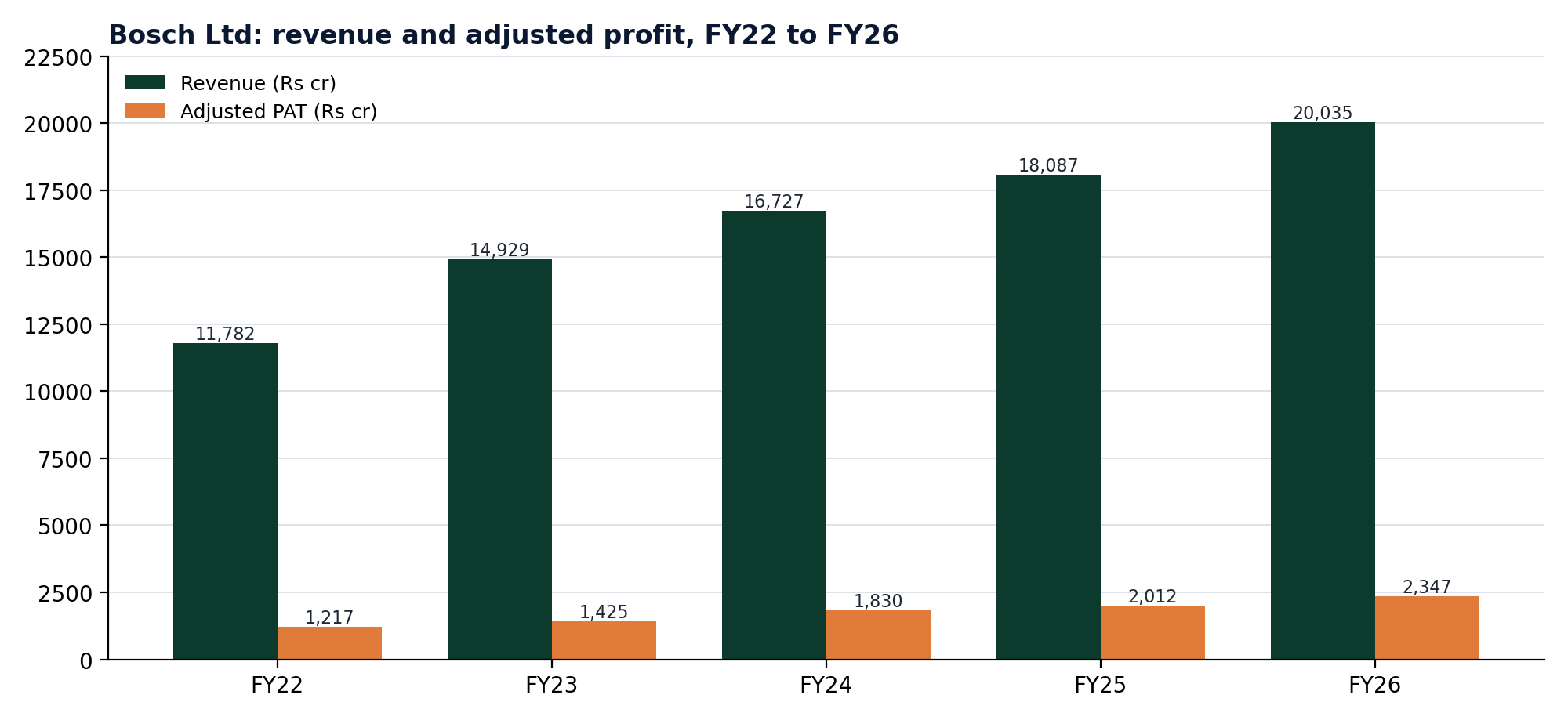
| Fiscal year | Revenue (Rs cr) | EBITDA (Rs cr) | EBITDA margin | Reported PAT (Rs cr) | Adjusted PAT (Rs cr) | Adjusted EPS (Rs) |
|---|---|---|---|---|---|---|
| FY22 | 11,782 | 1,462 | 12.4% | 1,217 | 1,217 | 413 |
| FY23 | 14,929 | 1,807 | 12.1% | 1,425 | 1,425 | 483 |
| FY24 | 16,727 | 2,095 | 12.5% | 2,491 | 1,830 | 621 |
| FY25 | 18,087 | 2,310 | 12.8% | 2,013 | 2,012 | 682 |
| FY26 | 20,035 | 2,650 | 13.2% | 2,770 | 2,347 | 796 |
| Q1 FY27 | 5,842 | 821 (operating profit) | 14% | 706 | 706 | 239 |
Screener.in, company results and broker results reviews (Motilal Oswal, May 21, 2026). FY24 reported PAT includes an exceptional gain of about Rs 844 crore and FY26 reported PAT includes the Rs 556 crore divestment gain: adjusted PAT strips both. Revenue compounded at about 14% over FY22 to FY26 and adjusted PAT at about 18%, while EBITDA margin moved only from 12.4% to 13.2%.
How strong are the balance sheet and cash flow?
Fortress grade. Net worth was about Rs 14,847 crore at FY26 end, borrowings Rs 7 crore, cash and bank balances about Rs 1,355 crore and investments about Rs 7,361 crore: a liquid book of about Rs 8,700 crore earning other income of Rs 800 crore plus a year. Return on capital employed was about 22% in FY26 and return on equity about 15% (Screener). Operating cash flow was about Rs 2,232 crore in FY26, close to adjusted profit. The honest split: reported free cash flow was negative in FY24 and FY26 as EV, electronics and chassis spending absorbed the year's cash, and positive in between. The FY26 dividend was Rs 270 a share, final only with no interim declared, about Rs 796 crore, a payout of about 29% of reported profit (down from 75% in FY25) and a yield of about 0.6%.
Who runs Bosch Ltd, and is governance clean?
A professional, parent-appointed team under Guruprasad Mudlapur, President of the Bosch Group in India and Managing Director of Bosch Ltd since July 1, 2023, with Sandeep Nelamangala as joint managing director; Soumitra Bhattacharya, the previous managing director, moved to Chairman. Delivery on the plain test: FY26 revenue growth accelerated to 10.8%, the non-core exit closed at a gain, chassis was consolidated, two transition joint ventures were signed with partners, dates and caps named, though the FY26 dividend was cut to Rs 270 a share. The recorded misses are pace items: hydrogen slower than hoped, EV content still small. Promoters hold 70.54%, flat since March 2020, with zero pledging; domestic institutions hold about 15.2% and foreign investors about 7.2% (September 2026).
Who competes with Bosch Ltd?
UNO Minda (about 51x earnings) and Minda Corp (about 29 to 30x) chase lighting, switches and EV components; Schaeffler India (about 44 to 45x, with an operating margin near 18% and ROCE near 28%) is the closest quality peer and trades cheaper than Bosch on better current returns; Motherson (about 37 to 38x) brings global scale without the technology premium; Bharat Forge and Endurance Technologies (about 34x) compete for two-wheeler and EV content. Bosch's defence is breadth: no Indian rival can quote on injection, braking, steering, electronics and software for the same platform. The threat is unbundling: vehicle makers sourcing EV motors, electronics and software from specialists and in-house units, platform by platform.
What is Bosch Ltd worth?
At Rs 44,500: about 56x adjusted FY26 EPS of about Rs 796, about 47x reported EPS of Rs 940, about 8.8x book value of about Rs 5,036, dividend yield about 0.6%, market cap about Rs 1,31,300 crore, about 11% below the 52-week high of Rs 50,000 and about 55% above the low of Rs 28,610. Motilal Oswal was Neutral in August 2026 with a target of Rs 43,728, below the then price. FY2029 scenarios (DalalBytes modelling on adjusted FY26 EPS of about Rs 796 and 2.949 crore shares): bear Rs 38,100 (8% EPS CAGR, about Rs 1,003 EPS, 38x), base Rs 55,200 (13% CAGR, about Rs 1,149 EPS, 48x), bull Rs 75,800 (18% CAGR, about Rs 1,307 EPS, 58x). The bear case sits about 14% below the reference price: at this multiple, disappointment is not cushioned.
What are the key risks for Bosch Ltd?
Valuation first: at about 56x adjusted earnings, a decade of clean compounding is already in the price. Powertrain transition: electric vehicles delete injection and exhaust content before they add power electronics and motor content of equal value, against specialists, global Tier 1s and in-house programmes. Perimeter risk: the group's software centre compounds outside the listed company while listed holders pay royalty of about 2 to 2.5% of sales. Margin risk: materials are about 64% of revenue and customers negotiate hard, so a vehicle downcycle or commodity spike lands on a 13.2% EBITDA margin. Hydrogen is an option, not a business: management guides to 10 to 15% of Indian heavy trucks by 2030 and concedes progress is slower than hoped.
© 2026 DalalBytes Research · For educational purposes only. Not investment advice.