
What is the verdict?
52/100. Neutral. A genuine platform technology whose stock has already been paid for the pivot, before the pivot has been proven durable.
| 52/100 | DalalBytes score |
| $7.31 | Reference price, Oct 20, 2026 close |
| ~$1.97B | Market cap, ~264M shares |
| $3 / $7 / $14 | FY2029 bear / base / bull |
Butterfly spent a decade proving that an ultrasound machine can be a semiconductor. The second act, begun in earnest in late 2025, is proving something harder: that other companies will pay rent on that semiconductor. Q2 2026 was the pivot's best evidence. Revenue hit a record $32.6M, up 39% year over year, at a record 71.4% gross margin, and the adjusted EBITDA loss narrowed to $1.4M from $6.2M. Management raised FY2026 revenue guidance to $119-123M. The stock responded across 2026 with a 92% year-to-date gain, a best-day-in-company-history +55.9% session on June 18, and a four-year high of $10.21 on October 6.
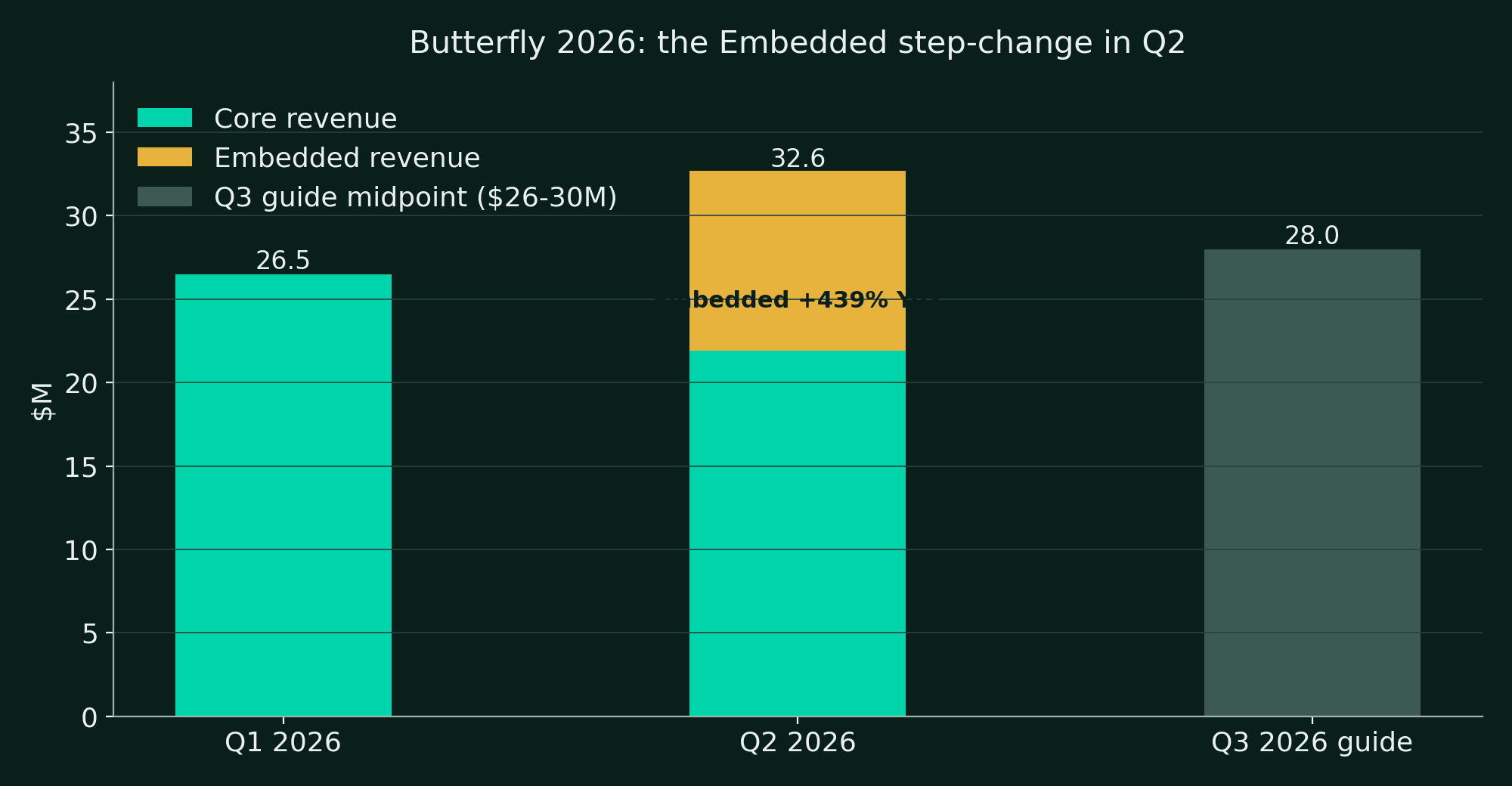
Now the anatomy. Of Q2's $32.6M, Core revenue (probes and software) was $21.9M, up just 2% year over year, with unit volumes up 23% but average selling price down 12% on mix. Embedded revenue was $10.8M, up 439%, and management attributes the bulk of it to one partner, Midjourney, whose full-body scanner (40 Butterfly modules per unit) was unveiled in June. A single partner's milestone schedule is now a third of the revenue line of a company valued at about $1.97B, or 17.3x trailing sales. Meanwhile the CEO sold shares at $10.00-10.02 under a 10b5-1 plan in August and October, the SPAC sponsor's fund sold about $20M of stock in August, and the CFO chair changed hands in December 2025 after the prior CFO resigned.
None of this makes the technology less real. It makes the price the question. At $7.31 the market is capitalizing the licensing platform as if the Midjourney ramp, the Merge Labs brain-computer interface deal, and a pipeline of 11 Embedded partners are recurring revenue. The filings describe milestone and license payments that are back-loaded and volume-conditional. Our base case lands almost exactly on today's price, which is the definition of a Neutral: the bull case ($14) requires Embedded to become a durable licensing platform by 2029, and the bear case ($3) requires only that it behaves like licensing revenue usually does. Q3 2026 earnings on October 29, guided to $26-30M of revenue with a wider EBITDA loss on milestone timing, are the next read.
The single most important unverified claim in this story
One trade-press report (business-news-today, uncorroborated) says Midjourney's third-generation scanner is expected to use custom silicon rather than Butterfly modules. If true, Butterfly's marquee partner designs it out over time and the Embedded story is a bridge, not a platform. We flag it prominently because the entire bull case turns on it, and we could not confirm or refute it from primary sources before publication.
What is Butterfly Network?
Jonathan Rothberg founded Butterfly in 2011 in Burlington, Massachusetts, after building 454 Life Sciences and Ion Torrent on the same conviction: replace bespoke scientific hardware with semiconductors and software. Butterfly raised more than $400M privately (Baillie Gifford, the Gates Foundation, Fosun among the backers) and merged with Longview Acquisition Corp., a Glenview Capital SPAC, in February 2021 at a valuation of about $1.5B. The stock peaked at $29.13 on February 18, 2021, and bottomed at $0.67 in April 2024. A securities class action over the SPAC proxy projections remains part of the record.
| Item | Value |
|---|---|
| Founded | 2011, Burlington, MA; de-SPAC closed February 2021 |
| Employees | about 220 |
| Revenue, FY2025 | $97.6M (US $77.4M, international $20.2M) |
| Cash, June 30, 2026 | $124.7M ($128.7M including restricted cash) |
| Debt | None. Liabilities of $93.6M are leases, deferred revenue, accruals |
| Accumulated deficit | $904.8M at June 30, 2026 |
| Share count | 264.4M total (238.0M Class A + 26.4M Class B) at June 30, 2026 |
| Control | Rothberg holds all Class B (20 votes/share), about 71% of voting power |
The business today has two reporting lenses. The GAAP lines are Product revenue and Software and other services. Management's lens is Core (the point-of-care ultrasound business: probes, memberships, Compass software) and Butterfly Embedded (licensing the chip and IP to other companies). Section 5 is the Embedded story; Section 6 is the Core business it is supposed to complement.
How does ultrasound-on-chip work?
Conventional ultrasound uses piezoelectric crystals, one transducer design per clinical application, which is why a hospital buys separate probes for cardiac, abdominal, and vascular work. Butterfly's Ultrasound-on-Chip replaces the crystals with a capacitive micromachined ultrasonic transducer (CMUT) array of roughly 9,000 elements integrated on a CMOS semiconductor chip. Because the array is electronic, beam steering is software-defined in all three dimensions with no moving parts, and one probe covers the body through presets rather than hardware swaps. TSMC manufactures the chip; the FY2025 10-K lists dependence on TSMC as a single-supplier risk. The current silicon family is branded the Poseidon family of Ultrasound-on-Chip.
| Generation | Launch | Launch price | Key advances |
|---|---|---|---|
| Butterfly iQ | 2017-2018 | $1,999 + membership | First handheld single-probe whole-body ultrasound; 9,000-element CMUT, 1-10 MHz, 313 g |
| Butterfly iQ+ | Oct 2020 | $1,999 + membership | On-chip digital micro-beamforming (15% faster frame rates, 60% faster pulse repetition); Needle Viz; Auto Bladder Volume; TeleGuidance; 309 g |
| Butterfly iQ3 | Feb 2024 | $3,899 + membership | 1-12 MHz; about 2x processing power; 17% smaller face, 300 g; iQ Slice and iQ Fan modes; up to 2 hours continuous scanning |
| P5.1-based probe | Planned Q1 2027 | n/a | Improved cardiac imaging (management) |
| iQ Station | Planned late 2027 | n/a | Cart-format entry into the $1.6-2B cart segment (management framing) |
| Apollo chip | In development | n/a | Next-generation architecture; delivery to Midjourney targeted end-2027 to early 2028 |
Imaging modes on the iQ3 span B-mode, tissue harmonic imaging, M-mode, biplane imaging, color and power Doppler, pulsed-wave Doppler, and the AI-assisted modes, across more than 20 anatomical presets, under FDA 510(k) K232808 and successors. The honest specification comparison is against Exo's Iris, the only architecturally similar rival (silicon-based, single 3-in-1 probe at $5,499): Butterfly is cheaper, earlier, and software-richer; Exo is wireless where the iQ3 is wired, and carries no mandatory subscription. Section 10 prices the field.
What is the software layer worth?
Hardware gets Butterfly into the room; software is where the recurring revenue is supposed to live. Butterfly Cloud (Cloud 2.0, 2022) handles storage, sharing, and proficiency management. Compass, the enterprise workflow platform originally launched as Blueprint, manages encounter-based workflow, quality assurance, credentialing, and charge capture. Compass AI, launched November 17, 2025, is the current flagship: an enterprise operating system for POCUS programs whose Documentation Agent uses ambient voice capture (the company claims charting time down 25%) and whose QA Agent reviews images with AI. The company claims documentation compliance up to 94% under Compass against about 15% captured under order-based workflows, translating to up to 5x billable revenue on the same scan volume. Those are company marketing figures footnoted to studies, and we treat them as directional, not audited.
Two 2026 developments extend the software story. The Gestational Age Tool won FDA clearance in March-April 2026: the first FDA-cleared blind-sweep AI for gestational age, trained on more than 21M images, developed with UNC Chapel Hill, validated for 16-37 weeks at accuracy comparable to sonographer biometry, and already deployed in Malawi and Uganda with Gates Foundation support. And the Butterfly Garden developer program (August 2023) grew from 21 AI partners at the end of 2024 to 30 by Q1 2026, with UltraSight's cardiac guidance live, DESKi's HeartFocus app launched in late 2025, and iCardio expected to go live with an FDA-cleared model in late 2026 or early 2027. A Beam Steering API, announced January 2026, opens the chip's software-defined steering to Garden and Embedded developers, which is the platform move in miniature: every layer of the stack gets an interface, and every interface is a future toll.
What is the Embedded pivot?
Butterfly Embedded (run through the subsidiary formerly branded Octiv) licenses the Ultrasound-on-Chip, the Poseidon silicon family, and the IP estate to companies building ultrasound into products that are not ultrasound machines. Eleven partners were signed by Q2 2026, with more than 40 companies engaged as of Q1 2026 (management figures).
| Partner | Deal | Terms and status |
|---|---|---|
| Midjourney | Full-body scanner; 40 Butterfly modules per unit | Five-year co-development and licensing agreement (Nov 17, 2025): $15M upfront + $10M per year license fee + up to $9M milestones, up to $74M total, plus revenue share and per-module payments on commercialization. Scanner unveiled June 2026; Midjourney targets a first facility in early 2028 and 50,000 scanners by 2031 (partner claims). Back-loaded and volume-conditional |
| Merge Labs | Brain-computer interfaces | Multi-year licensing agreement (Sep 1, 2026): Butterfly is the exclusive CMOS-MEMS chip-based ultrasound partner; upfront and milestone license payments, hardware purchase commitments, technology access fees, future royalties. Dollar figures not disclosed. Merge launched January 2026 with a $252M seed (OpenAI, Bain Capital, others) |
| Mendaera | Robotic needle guidance | First Embedded partner (2023), revenue share per combined unit sold. Its FDA-cleared Focalist system, with a customized iQ3, became commercially available October 1, 2026: the first Embedded partner product to reach market |
| Sonic Incytes | Liver disease assessment | Named partner since Q4 2024 |
| Others | BCI (a second licensee, Bridge Neurotech, reported October 2026, single-sourced), women's-health wearable, others unnamed | Two partners added in Q2 2026, both unnamed |
The strategic logic is genuinely attractive: the same CMUT die, sold as silicon and licenses at software-like gross margins, into markets (consumer wellness scanning, neurotechnology) that a 220-person medical-device company could never sell into directly. The Q2 2026 numbers show the model working: $10.8M of Embedded revenue at the company level helped produce a 71.4% gross margin. The concentration is the counterweight: management attributes Q2's Embedded revenue primarily to Midjourney, the deal payments are back-loaded, and the scanner that carries the volume does not open its first facility until early 2028 on Midjourney's own timeline. Add the unverified design-out report flagged in Section 1, and Embedded today is a promising, concentrated, milestone-driven revenue line being priced as an annuity.
Embedded revenue quality
Q2 2026 product revenue (the GAAP line) actually fell 5.4% year over year while software and services rose 150%. The growth engine is licensing recognition, not unit shipments. Licensing recognition follows contract milestones, which is why management guides Q3 2026 revenue down sequentially to $26-30M with the EBITDA loss widening to $6-9M. Expect lumpiness, and judge this segment on cash collected and partners reaching market, not on any single quarter's recognition.
How is the Core business doing?
The Core business sells probes, memberships, and Compass software to hospitals, medical schools, and (increasingly) home-care providers. Its flagship proof point remains the University of Rochester Medical Center deployment (January 2022, thousands of iQ+ probes system-wide), where the company reported ultrasound charge capture up 116% with devices plus Compass in September 2024. Compass AI began converting that story into software contracts in 2026: the first enterprise contract closed in Q1 2026, including a seven-figure total contract value deal; six more enterprise software deals signed in Q2 2026; management says the software pipeline (TCV) is up about 5x year over year.
Medical education is the quiet volume channel: a multi-year agreement with VCOM (Edward Via College of Osteopathic Medicine) worth more than $10M of total contract value over four years for a 1:1 student probe program, about 1,000 probes across six medical-school institutions in early 2026, and the iQ3 Vet (October 2025) extending the third-generation probe into veterinary programs. Home and Community Care began its first state implementation on October 1, 2026, with first revenue expected in Q4 2026 and a larger rollout possible in 2027; management has cited a $40-60M revenue opportunity from a single home-care customer population (a management claim from the Q2 2025 call, not a contract).
The pace, however, is the issue. Core revenue grew 2% year over year in Q2 2026. Probe unit sales rose 23%, but average selling price fell 12% on iQ+ mix and education-deal subsidies. International revenue fell 14% in the quarter on distributor order timing. A top-five US health system signed a system-wide deal in Q2 2025 (unnamed, terms undisclosed), and one customer was about 11% of FY2025 revenue. Core is a real business with real reference accounts; it is not currently a growth business, and no honest reading of the filings can call it one. The growth story is Embedded or it is nothing.
What do the financials show?
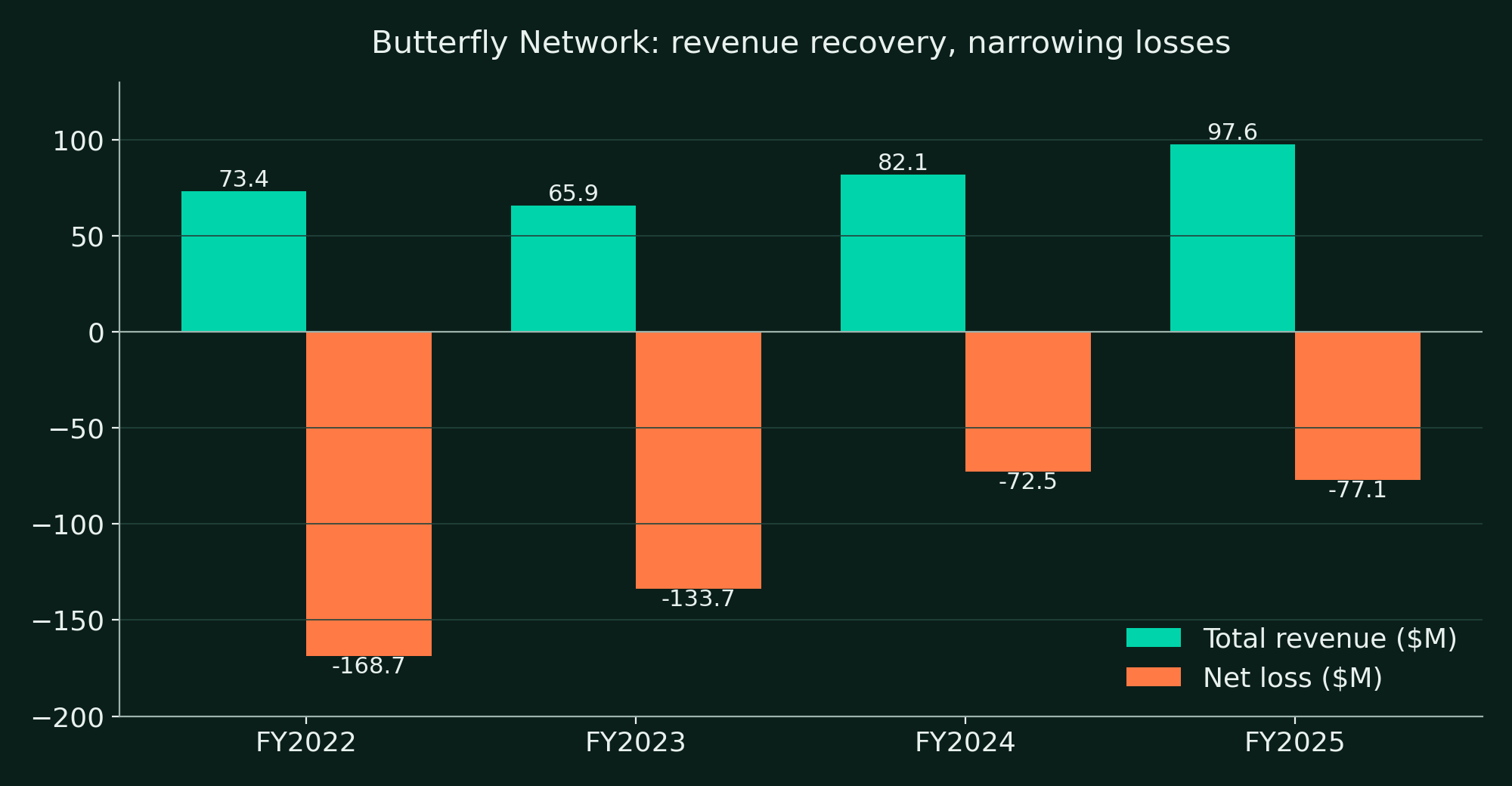
| $M | FY2022 | FY2023 | FY2024 | FY2025 |
|---|---|---|---|---|
| Product revenue | 50.26 | 40.04 | 54.20 | 63.44 |
| Software and other services | 23.13 | 25.86 | 27.86 | 34.17 |
| Total revenue | 73.39 | 65.90 | 82.06 | 97.61 |
| Gross profit (GAAP) | 39.46 | 16.86 | 48.83 | 45.73 |
| Gross margin (GAAP) | 53.8% | 25.6% | 59.5% | 46.9% |
| Adjusted gross margin | about 54% (Q4) | 58.8% | 59.6% | 64.9% |
| Operating loss | (193.02) | (145.61) | (74.41) | (86.42) |
| Net loss | (168.7) | (133.70) | (72.49) | (77.06) |
| Adjusted EBITDA | n/d | (67.50) | (38.88) | (26.5) |
| Cash and restricted cash, year-end | 242.0 | 138.65 | 92.79 | 154.50 |
| Weighted average shares | about 200M | 205.4M | 211.7M | 247.1M |
Sources: FY2025 10-K and company releases. GAAP gross margin is repeatedly distorted by inventory and vendor charges, and the report reader should use the adjusted line for trend: FY2023 GAAP margin of 25.6% includes $21.89M of inventory write-downs concentrated in Q4 2023 (that quarter's GAAP margin was -75.9%), and FY2025's 46.9% includes $17.60M of write-downs and write-offs of inventories and vendor advances. Note also that FY2025's operating loss widened against FY2024 despite revenue growth, because of those cost-of-revenue charges and higher other operating expense.
| $M | Q1 2026 | Q2 2026 |
|---|---|---|
| Revenue | 26.5 (+25% YoY) | 32.6 (+39% YoY) |
| Gross margin | 68.9% | 71.4% (record) |
| Net loss | (12.7) | (12.9) |
| Adjusted EBITDA | (6.1) | (1.4) |
| Cash and equivalents (quarter-end) | 138.0 | 124.7 |
Has management delivered on its roadmap?
Butterfly's guidance credibility under the current team is better than its SPAC-era reputation, and the audit should separate the two regimes honestly. The 2020 proxy projections that underpin the class action were missed catastrophically: FY2023 revenue of $65.9M actually declined 10% year over year, and the FY2022 net loss of $168.7M was more than five times FY2021's. That regime ended with two restructurings (about 60 roles in August 2022, a further 25% workforce reduction in January 2023), a CEO change, and a cost base cut from $232.5M of operating expense in FY2022 to $162.5M in FY2023.
| Period | Guidance | Actual | Score |
|---|---|---|---|
| FY2024 | Raised Nov 2024: revenue $79-81M; adj. EBITDA loss $40-42M | Revenue $82.06M; adj. EBITDA -$38.9M | Beat both |
| FY2025 | Feb 2025: revenue $96-100M; adj. EBITDA loss $37-42M. Cut at Q2 2025: revenue $91-95M; loss $32-37M, on delayed enterprise and global-health deals | Revenue $97.61M; adj. EBITDA -$26.5M | Revenue inside the original range, above the cut; EBITDA better than both guides |
| FY2026 | Feb 2026: revenue $117-121M; adj. EBITDA loss $21-25M. Raised at Q2 2026: revenue $119-123M; loss $19-23M | H1 revenue $59.1M; H1 adj. EBITDA -$7.5M | Tracking ahead on EBITDA; Q3 guided down sequentially on milestone timing |
Management's profitability language is deliberately soft: DeVivo framed the January 2025 raise as "a bridge to cash flow independence," and the demonstrated milestones are real (total cash use of $19.4M in 2025 excluding offering proceeds, against $45.9M in 2024; a first positive-cash-flow quarter claimed for Q4 2025 at +$6.3M). The forward roadmap items to audit next: the P5.1 probe launch (Q1 2027), iQ Station's cart entry (late 2027), Apollo chip delivery to Midjourney (end-2027 to early 2028), HomeCare revenue (from Q4 2026), and full FedRAMP certification (management expected Q3 2026, with provisional VA authorization already in hand).
How strong is the balance sheet?
The balance sheet is simple and unforgiving. Cash of $124.7M at June 30, 2026, no borrowings, total liabilities of $93.6M (leases, deferred revenue, accruals), equity of about $196M at the end of 2025, and an accumulated deficit of $904.8M. H1 2026 operating cash use was about $30M (Q2 alone $13.3M), partly offset by $6.3M of option-exercise and ESPP inflows. At the H1 burn pace, runway is roughly two years, and H2 guidance (Q3 EBITDA loss of $6-9M) implies no sudden improvement. Stock-based compensation was $23.4M in FY2025, about a quarter of revenue, and about $7.0M in Q2 2026 alone (single-sourced release summary).
The share count is the ledger where dilution lives:
| Date | Event | Effect |
|---|---|---|
| FY2023 | Weighted shares | 205.4M |
| Jan 2025 | Public offering | 27.6M shares at $3.15; $81.7M net proceeds; about 11% of shares outstanding, priced at a 10.3% discount |
| FY2025 | Weighted shares | 247.1M (offering plus equity comp) |
| H1 2026 | Class A shares outstanding | 227.3M to 238.0M, +10.7M in six months via exercises and equity comp |
| Jun 2026 | Total shares | 264.4M including Class B |
From the January 2025 raise price of $3.15, the stock at $7.31 has more than doubled, which makes the next raise a choice rather than a necessity, for now. But the arithmetic of this company is that every year of sub-scale operation has been part-paid in shares, and a 7%-a-year share-count growth assumption is what consensus models carry. The fortress question is answered in the pillar analysis; here it is enough to say the company has time, not surplus.
Who competes with Butterfly, and at what price?
Estimates of the point-of-care ultrasound market vary by definition, and we show the range rather than a false point estimate: total POCUS at about $4.2B in 2025 (GMI, with handheld at $1.54B of it) to $6.0B in 2026 (Coherent MI); the compact/handheld segment is forecast to reach about $5.18B by 2035 at an 8.1% CAGR (GMI). No reliable published share table for handheld units exists. Vendor rankings consistently put GE HealthCare (Vscan) and Philips (Lumify) first, with Butterfly, Fujifilm Sonosite, Clarius, Mindray, Canon, and Samsung Medison in the set.
| Device | Hardware price | Subscription | Notes |
|---|---|---|---|
| Butterfly iQ3 | $3,899 | Required: Core $299/yr; Advanced $420/yr or $1,500/5 yrs | Single wired CMUT probe, whole-body presets, about 300 g |
| GE Vscan Air SL / CL | $4,999 | None required | Wireless, dual-headed (sector + linear, or convex + linear) |
| Clarius C3 HD3 | $3,590 | $595/yr membership | Convex-only per probe; multi-probe family |
| Clarius PAL HD3 | $5,395 | $695/yr Essentials | Phased + linear, wireless |
| Exo Iris | $5,499 | Base none; Connect $500/yr | Single 3-in-1 silicon probe; Samsung Medison took a strategic stake and co-development deal in May 2025 |
| Philips Lumify | about $7,000+ per probe | Optional | Separate phased, linear, curved probes; wired |
| Mindray TE Air | from $4,499-6,699 | None | Wireless, piezoelectric |
| Chinese dual-head devices | about $2,700-2,976 | None | Dual-head convex + linear + phased; undercut Butterfly by about $900-1,200 |
Source: US buying-guide and reseller listings checked October 2026; list prices move with promotions. The structural read: Butterfly is the cheapest branded Western single-probe system, and the only major vendor that requires a membership to use hardware the customer already bought. GE also competes from above (Venue Sprint tablet consoles, and Caption Health's AI guidance, acquired 2023, now inside GE's ecosystem, a direct hit on Butterfly's former AI partner). Exo is the strategic threat that matters most: the same silicon thesis, a premium single probe, and Samsung Medison's balance sheet behind it since May 2025. A possible regulatory tailwind runs the other way: in the EU RoHS review of lead-based piezo ultrasound, the consultant recommended limiting the handheld exemption to two years, the minimum, per the company's Q1 2026 call summary. Lead-free CMUT would benefit if that becomes law; it is a consultant recommendation, not an EU decision.
Reimbursement remains the industry's soft underbelly. There is no POCUS-specific CPT code; scans bill under standard ultrasound codes (limited extremity 76882 at about $58 global, limited echo 93308 at about $102, per GE's reimbursement guide), and in hospital outpatient settings the technical component is packaged into imaging APCs, so facilities often capture little incremental payment per scan. That is why Butterfly sells workflow and charge capture (Compass AI) rather than per-scan economics, and why the CY2027 OPPS proposal to pay imaging APCs at physician-fee-schedule rates, if finalized, squeezes the customer's budget further. The reimbursement clarity problem is not Butterfly's alone; it is the category's.
Who leads Butterfly, and who controls it?
Jonathan Rothberg is the founder (2011) and controls about 71% of the voting power through 26.4M Class B shares at 20 votes each, against a direct economic stake of about 2.1% of Class A (13D/A, December 2025). He served as interim CEO from December 2022 to April 2023 and is now Founder and Director; the chairmanship sits with CEO Joseph DeVivo. This is a controlled company under NYSE rules, and the structure is the governance fact that colors everything: a founder with super-voting control and a small economic stake is the classic asymmetric-incentive setup, and no board dynamic can overrule it.
DeVivo's operating record since April 2023 is the reason the current team has credibility. He ran InTouch Health to an acquisition by Teladoc and was Executive Chairman of Caption Health (AI ultrasound guidance, acquired by GE HealthCare in 2023) before taking Butterfly. Under him, the cost base was reset, FY2024 and FY2025 guidance was met or beaten, the Embedded pivot was launched and monetized, and the CFO chair transitioned to John Doherty (December 8, 2025) after Heather Getz resigned in August 2025; Doherty came from Magic Leap, Kaltura, and InterXion with a long restructuring-financing record. Board composition moved toward the silicon thesis in October 2026 with the appointment of Mike Noonen (ex-GlobalFoundries, NXP, CEO of photonics startups) explicitly tied to the semiconductor-licensing business.
The insider tape is the deduction. Executives sell persistently into strength, mostly 10b5-1 and sell-to-cover:
| Period | Insider | Action |
|---|---|---|
| Nov-Dec 2025 | Glenview Capital (Robbins) | Bought about 4.36M shares at $2.58-3.06 |
| Mar-Aug 2026 | DeVivo | Sold in tranches at $2.44-$10.02, including $10.00-10.02 in Aug-Oct 2026 under 10b5-1; holds 7.31M shares direct |
| Aug 13, 2026 | Robbins (Glenview) | Sold 2.30M shares at $8.9751 (about $20.6M), plus further blocks at $8.70-9.54, cutting the stake sharply |
| Aug 2026 | Phanstiel (director) | Bought 115,200 shares at $8.6763 (about $1.0M) |
| May 2025 | Getz (ex-CFO) | Sold 65,456 shares at $2.20 pre-departure (single-sourced) |
Sources: Form 4 data via financial press and SECForm4. The signal is not fraud; it is price. The SPAC sponsor's fund bought near the bottom and sold into the rally, and the CEO's 10b5-1 program monetizes the top of the range. Only one director (Phanstiel) bought in 2026, twice. At a 52/100 Neutral, the insider record is consistent with the verdict: the team that built the pivot is happy to let the market own the priced-in version of it.
What is Butterfly worth?
| Metric | Value |
|---|---|
| Price | $7.31 (close, Oct 20, 2026) |
| Market cap | about $1.97B |
| Enterprise value | about $1.78-1.85B ($124.7M cash, no traditional debt) |
| TTM revenue | $102.9M |
| EV / Sales (TTM) | 17.3x |
| EV / Sales on FY2026 guide ($119-123M) | about 14.5-15.5x |
| Consensus | Moderate Buy; average target about $8.54-8.75 |
| 2026 analyst actions | TD Cowen reiterated Buy at $10 (Sep 11); Needham initiated Buy at $10 (Sep 22); Evercore ISI initiated Outperform at $15 (Sep 29); Canaccord initiated Buy at $10 (Oct 12-13); Weiss Ratings reiterated Sell |
| Short interest | 31.6M shares, 15.23% of float, 4.8 days to cover (FINRA Sep 30, 2026), down 11.4% period over period |
Sources: Finviz, Finnhub, MarketBeat, October 2026 snapshots. The initiation cluster in September-October 2026, led by Evercore's $15, drove the run to $10.21; the 27% fade since suggests the market wants the licensing platform proven in cash, not in initiation notes. At 17.3x trailing sales for $103M of revenue, Butterfly prices like a software company while delivering the revenue lumpiness of a licensing shop. For scale, the FY2026 revenue guide midpoint of $121M is roughly the quarterly revenue of one mid-sized Clarius channel. The multiple is a bet on the Embedded terminal value, which is our bull case, not our base case.
What are the FY2029 scenarios?
| Scenario | FY2029 revenue | Basis | Exit EV/Sales | Enterprise value | Target |
|---|---|---|---|---|---|
| Bear | $150M | Embedded proves lumpy and Midjourney-dependent; design-out risk materializes; Core flat; another raise dilutes | 5x | $750M + about $50M net cash | $3 |
| Base | $235M | Core grows high-single digits (enterprise + education + HomeCare); Embedded becomes a real but lumpy $60-80M line with 2-3 shipping partners | 8x | $1.88B + about $60M net cash, about 285M shares | $7 |
| Bull | $360M | Scanner volumes ship, Merge BCI and one more platform-scale licensee monetize, Compass AI becomes a health-system standard | 11x | $3.96B + cash, about 295M shares | $14 |
The base case lands at $7 against a $7.31 reference price. That is not a coincidence in the model; it is the honest arithmetic of a company whose reported growth is concentrated and conditional, priced at 17x sales. The bull case requires 2027-2028 to deliver what 2025-2026 promised: partners reaching market (Mendaera's Focalist just did, in October 2026), milestones converting to cash, and no design-out of the marquee partner. From $7.31, the base case implies roughly -1% annualized, the bull about 18%, the bear about -24% a year. This is a show-me stock at show-me prices, and we see no reason to pay for the proof before it exists.
What do the technicals say?
BFLY closed at $7.31 on October 20, 2026, down from the October 6 four-year high of $10.21 intraday, a 27% fade in a month. The price sits below the 50-day average ($8.40) but above the 200-day ($5.93), a bullish-long-term, bearish-short-term structure. Year to date the stock is up 91.8% from a $3.80 year-end close; over one year it is up about 242%, off a $1.90 52-week low and a $0.67 all-time low in April 2024. Average daily volume runs about 5.5-6.4M shares, roughly $36M of daily traded value, liquid enough for the thesis but thin enough that partner news moves it 50% in a session, as June 18 (+55.9%, 60.5M shares on the Midjourney scanner reveal) and February 26 (+51% on Q4 2025 earnings) demonstrated. Short interest of 15.2% of float is covering into the rally rather than building. The tape pattern is a story stock finding a new holder base after the initiation cluster; the chart from here belongs to Q3 earnings on October 29 and to whatever Midjourney does next.
What are the risks?
- Partner concentration. Embedded was about 33% of Q2 2026 revenue and is primarily Midjourney. One partner's milestones, timelines, and ultimately its silicon strategy, are now the margin of safety of a $2B valuation.
- The design-out question. The uncorroborated report that Midjourney's third-generation scanner moves to custom silicon is the highest-impact, lowest-verifiability claim in the file. It cannot be dismissed (it is the economically natural path for a device maker at scale) and it cannot be priced (it is a single unconfirmed source).
- Patent litigation. Fujifilm Sonosite sued in March 2022 alleging infringement of seven US patents covering portable handheld ultrasound fundamentals. Butterfly called the suit meritless in 2022; no outcome, settlement, or judgment headline surfaced in the sources reviewed for this report. An adverse result could reach into the chip licensing the whole pivot depends on.
- Runway and dilution. About two years of cash at H1 burn pace, improving. The January 2025 raise was at $3.15; a 2027 raise, if the Embedded ramp slips, happens from a position of less weakness but with the same mechanical effect on per-share value.
- Subscription friction. Butterfly is the only major vendor requiring a membership ($299-420/year) to operate purchased hardware. In enterprise and education deals this is an accepted SaaS bundle; in the individual practitioner market, where GE, Mindray, and Chinese dual-heads sell subscription-free, it is a conversion tax that shows up in unit economics, not in press releases.
- Reimbursement. No POCUS-specific code exists; facility economics are packaged and thin; a CY2027 OPPS proposal would compress them further if finalized. The Compass AI charge-capture story is the mitigant, and it is a company claim, not an audited outcome.
- Founder control. About 71% voting power with about 2% economic ownership. The SPAC-era record happened under the same control structure. It has not been tested in this cycle.
What should investors watch next?
Q3 2026 earnings arrive Thursday, October 29, 2026, at 8:00 AM ET (company-confirmed). Management's guide is $26-30M of revenue with an adjusted EBITDA loss of $6-9M, a sequential step down that management attributes to milestone timing. The watch list: the Core versus Embedded split (is the 439% growth repeating, or was Q2 a milestone spike?), any color on Midjourney's scanner timeline and module volumes, HomeCare's first revenue in Q4, cash burn against the $124.7M base, and any disclosure on the Sonosite litigation or the Midjourney silicon path.
The conclusion is the verdict made plain. Butterfly has built something no competitor had: a programmable ultrasound chip, a growing AI software layer, and now paying customers for both. The 2026 run repriced the company as though the licensing platform is proven. It is not, by the filings' own description: concentrated, back-loaded, milestone-driven, and two years from its first partner facility. We score 52/100, Neutral, with FY2029 targets of $3 / $7 / $14. The base case is the current price. Let 2027-2028 make the bull case, or the bear case, and revisit then.
The proof points that would raise the score
Two more Embedded partners reaching commercialization (Mendaera just did), cash collected on the Midjourney milestones matching the revenue recognized, and Core revenue growth returning to double digits with Compass AI as the driver. Those three, and the Neutral becomes a licensing-platform compounder. A design-out confirmation, or a litigation loss, and it reverts to a probe company priced like a platform.
Frequently asked questions
What is Butterfly Network's Ultrasound-on-Chip?
A capacitive micromachined ultrasonic transducer (CMUT) array of about 9,000 elements integrated on a CMOS semiconductor chip, manufactured by TSMC, which replaces piezoelectric crystals and lets one probe image the whole body through software-defined beam steering.
What is Butterfly Embedded, and why does it matter for the valuation?
Butterfly Embedded licenses the ultrasound chip, silicon, and IP to other companies. It was $10.8M of Q2 2026's $32.6M revenue, up 439% year over year, primarily from the Midjourney scanner deal (up to $74M over five years), plus deals with Merge Labs, Mendaera, and Sonic Incytes.
What are the DalalBytes FY2029 targets for BFLY?
Bear $3, Base $7, Bull $14, built on FY2029 revenue of $150M, $235M, and $360M respectively, against a reference price of $7.31 on October 20, 2026.