Frequently asked questions
Is Abbott India a buy at current prices?
DalalBytes rates Abbott India Selective Positive at 74/100. It ranks second in the Indian pharmaceutical market with about 6.3% share, trades at 35.5 times FY26 EPS of Rs 730.36 near its 52-week low of Rs 25,135, earns about 45% return on capital employed, and paid out about 90% of FY26 profit as dividends, a yield of about 2.5%.
What are Abbott India's FY2029 price targets?
DalalBytes' FY2029 targets for Abbott India are bear Rs 27,600, base Rs 36,900, and bull Rs 47,900, from a Rs 25,905 reference price (NSE close, October 19, 2026). Scenarios build on FY26 EPS of Rs 730.36. Bear: 8% EPS CAGR, about Rs 920 EPS, 30x. Base: 12%, about Rs 1,026, 36x. Bull: 16%, about Rs 1,140, 42x.
What is the verdict on Abbott India?
The business quality grades in the high 80s: category-leading power brands, operating margin of 27% in FY26 and 29% in Q1 FY27, return on capital employed of about 45%, borrowings of Rs 172 crore against cash of Rs 2,255 crore, and a payout of about 90% that minority holders actually receive. Three deductions bring it to 74: revenue growth slowing to 4.3% in Q1 FY27, a largest brand block (the Novo Nordisk insulins and Rybelsus) that Abbott markets but does not own, in the therapy GLP-1 drugs are disrupting, and a 35.5x multiple with no re-rating fuel unless growth re-accelerates.
How did Abbott India start?
The company was incorporated on August 22, 1944 as Boots Pure Drug Company (India) Ltd and listed in Mumbai in the mid 1960s. It became Abbott India Ltd on July 1, 2002, after Abbott Laboratories of the US acquired the Knoll business from BASF globally. The Goa formulation plant opened in 1996, the Solvay Pharma India merger of 2011 deepened the gastro and women's health shelf, and global brand transfers plus the marketed Novo Nordisk insulin portfolio filled diabetes care. Heritage brands still earn: Cremaffin dates to 1952, Brufen to 1973, and Thyronorm (1999) completed 25 years in India as the market-leading levothyroxine brand.
What does Abbott India sell?
A branded formulations shelf, detailed to doctors and dispensed by brand name. Metabolics and thyroid: Thyronorm and Neo-Mercazole. Diabetes care: Mixtard, Novomix, Actrapid, Novorapid, Ryzodeg, Tresiba and Rybelsus, the largest monthly sales block, and a marketed (not owned) portfolio. Gastroenterology: Udiliv, Duphalac, Cremaffin Plus, Digene and Stemetil. Women's health: Duphaston. CNS: Vertin and Prothiaden. Pain: Brufen and Kenacort. Vaccines are the newest owned leg, growing about 18% on MAT September 2025. The technical moat is dose trust: levothyroxine is a narrow therapeutic index drug where stabilised patients resist switching, and insulin adds cold-chain and device familiarity.
How do the brand deals and launches fit?
Abbott India has not bought scale. Growth comes from parent brand transfers, marketing arrangements such as the Novo Nordisk insulins, and line extensions: more than 100 launches in 12 years, about 75 more planned over five years, with FY25 launches including Citrosoda UTI, Digene Insta, Digeraft, Vonefi, Duphaston OD, Pneumoshield 14 and Prothiaden Neu. The deal caveat matters: distribution economics on a partner's brands are capital-light and attractive, but terms can change, brands can be taken in-house, and volumes can shift to newer molecules. Broker notes already record slowdown in Mixtard and Novomix, and flag lumpiness in etail distribution margins.
What do Abbott India's financials show?
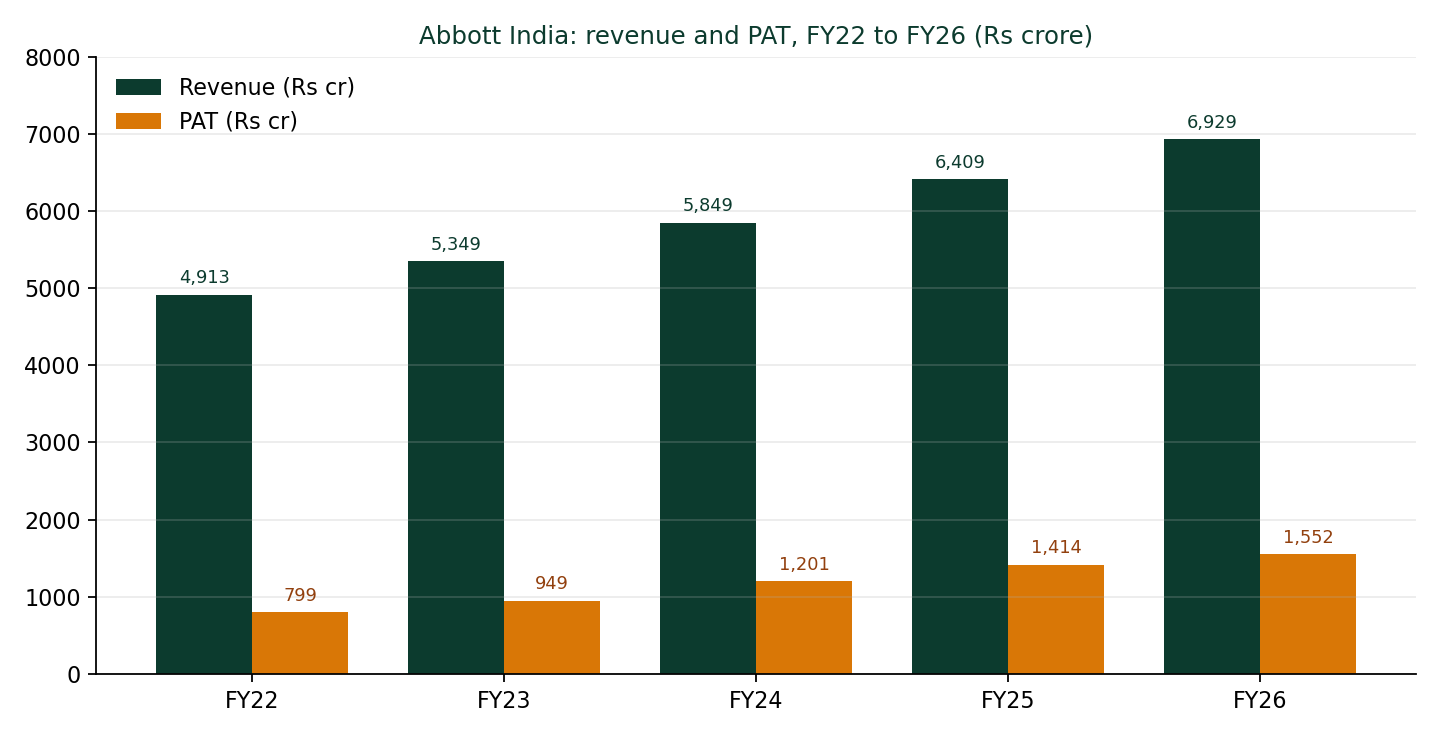
| Fiscal year | Revenue (Rs cr) | Operating profit (Rs cr) | OP margin | PAT (Rs cr) | EPS (Rs) |
|---|---|---|---|---|---|
| FY22 | 4,913 | 1,082 | 22% | 799 | 375.86 |
| FY23 | 5,349 | 1,205 | 23% | 949 | 446.78 |
| FY24 | 5,849 | 1,453 | 25% | 1,201 | 565.28 |
| FY25 | 6,409 | 1,692 | 26% | 1,414 | 665.62 |
| FY26 | 6,929 | 1,892 | 27% | 1,552 | 730.36 |
| Q1 FY27 | 1,814 | 522 | 29% | 429 | 201.66 |
Screener.in and company results. Revenue compounded at about 9% over FY22 to FY26 while PAT and EPS compounded at about 18% on five points of margin expansion. Q1 FY27 revenue grew 4.3% and PAT 17.1% year on year: margin carried the quarter.
How strong are the balance sheet and cash flow?
Fortress grade, asset-light. Net worth was about Rs 4,774 crore at FY26 end, borrowings Rs 172 crore (debt to equity 0.04), cash and bank balances Rs 2,255 crore, return on capital employed about 45% and return on equity about 34%. One main plant at Goa plus third-party manufacturing keeps capex small, so profit converts to cash by default. The FY26 dividend payout was about 90%: roughly Rs 1,394 crore, about Rs 656 a share, a yield of about 2.5% at the reference price, paid without touching debt. The flip side: little is retained, so there is no self-funded war chest, and the parent at 74.99% receives three quarters of every dividend, which is also the alignment: minority holders get the same cheque per share.
Who runs Abbott India, and is governance clean?
A professional team under Managing Director Kartik Rajendran, within Abbott's global pharmaceuticals division. The August 2026 chairman transition was orderly: Munir Shaikh stepped down on August 12, 2026 and independent director Sudarshan Jain, a veteran Indian pharma leader, took over on August 13, with Q1 FY27 results approved in the same cycle under an unqualified limited review by Walker Chandiok and Co. LLP. Delivery on the plain test: margin expanded every year, launch tempo held, vaccines grew about 18%, and the payout rose to about 90% and was paid. Promoters hold 74.99%, unchanged, with zero pledging. The structural deduction is parent control of pipeline, brand ownership and policy.
Who competes with Abbott India?
Sun Pharma leads the Indian market at about 8.1% share with global specialty and US exposure; Cipla is third at about 5.6% with respiratory leadership and US generics; Mankind is the faster-growing domestic pure play. Abbott's closest model peers are the other MNC subsidiaries: branded, India-only, high payout, no US FDA plant risk and no discovery bill. Abbott grows revenue slower than Sun or Mankind and converts profit to dividends at a rate none of them match. The competitive fact of the year sits in diabetes: Eli Lilly's Mounjaro became India's largest brand by value in August 2026, pressuring the whole insulin-led model.
What is Abbott India worth?
At Rs 25,905: 35.5x FY26 EPS of Rs 730.36, about 11.5x book value of about Rs 2,247, dividend yield about 2.5%, market cap about Rs 55,050 crore, and a price near the bottom of the 52-week range of Rs 25,135 to Rs 30,655, down about 13 to 15% over one year. Approximate peer multiples at October 19, 2026: Sun Pharma about 35x, Cipla about 32x, Dr Reddy's about 31x, Mankind about 45x. Abbott sits at the top of the large-cap band on return on capital, payout and zero US regulatory risk, all real, all priced. FY2029 scenarios (DalalBytes modelling on FY26 EPS of Rs 730.36 and 2.125 crore shares): bear Rs 27,600 (8% EPS CAGR, about Rs 920 EPS, 30x), base Rs 36,900 (12% CAGR, about Rs 1,026 EPS, 36x), bull Rs 47,900 (16% CAGR, about Rs 1,140 EPS, 42x). The base case is about 42% above the reference price before dividends.
What are the key risks for Abbott India?
Growth risk first: a multi-year 4 to 5% revenue path would compress both earnings growth and the 35.5x multiple. Partner risk: the Novo Nordisk insulin and Rybelsus block is marketed, not owned; repricing, in-housing or a faster GLP-1 shift away from premix insulins hits the biggest brands first. Price risk: essential-medicine price ceilings, trade-generic substitution and e-pharmacy discounting, with narrow therapeutic index trust protecting Thyronorm more than acute brands such as Digene and Brufen. Governance risk is the standard MNC one: strategy, transfer pricing and royalty terms are set with a 74.99% parent, benign and lucrative to date, but not in minority hands.
© 2026 DalalBytes Research · For educational purposes only. Not investment advice.