How is the ranking built?
Three axes, each scored 1 to 10:
Survivability. Balance-sheet strength, cash generation, funding access, and maturity profile, if capital markets closed for a year.
Vulnerability (10 = most exposed). Single points of failure: customers, counterparties, refinancing, regulation, dilution.
Growth potential. Backlog relative to size, revenue slope, and pipeline.
The combined score weights survivability at 40%, growth at 35%, and safety (10 minus vulnerability) at 25%.
| Rank | Company | Survivability | Vulnerability | Growth | Combined |
|---|---|---|---|---|---|
| 1 | Nebius (NBIS) | 7 | 5 | 10 | 7.6 |
| 2 | Akamai (AKAM) | 9 | 3 | 5 | 7.1 |
| 3 | IREN | 6 | 7 | 9 | 6.3 |
| 4 | Applied Digital (APLD) | 5 | 7 | 8 | 5.6 |
| 5 | CoreWeave (CRWV) | 4 | 8 | 9 | 5.3 |
| 6 | Cipher Digital (CIFR) | 4 | 8 | 8 | 4.9 |
| 7 | TeraWulf (WULF) | 3 | 9 | 7 | 3.9 |
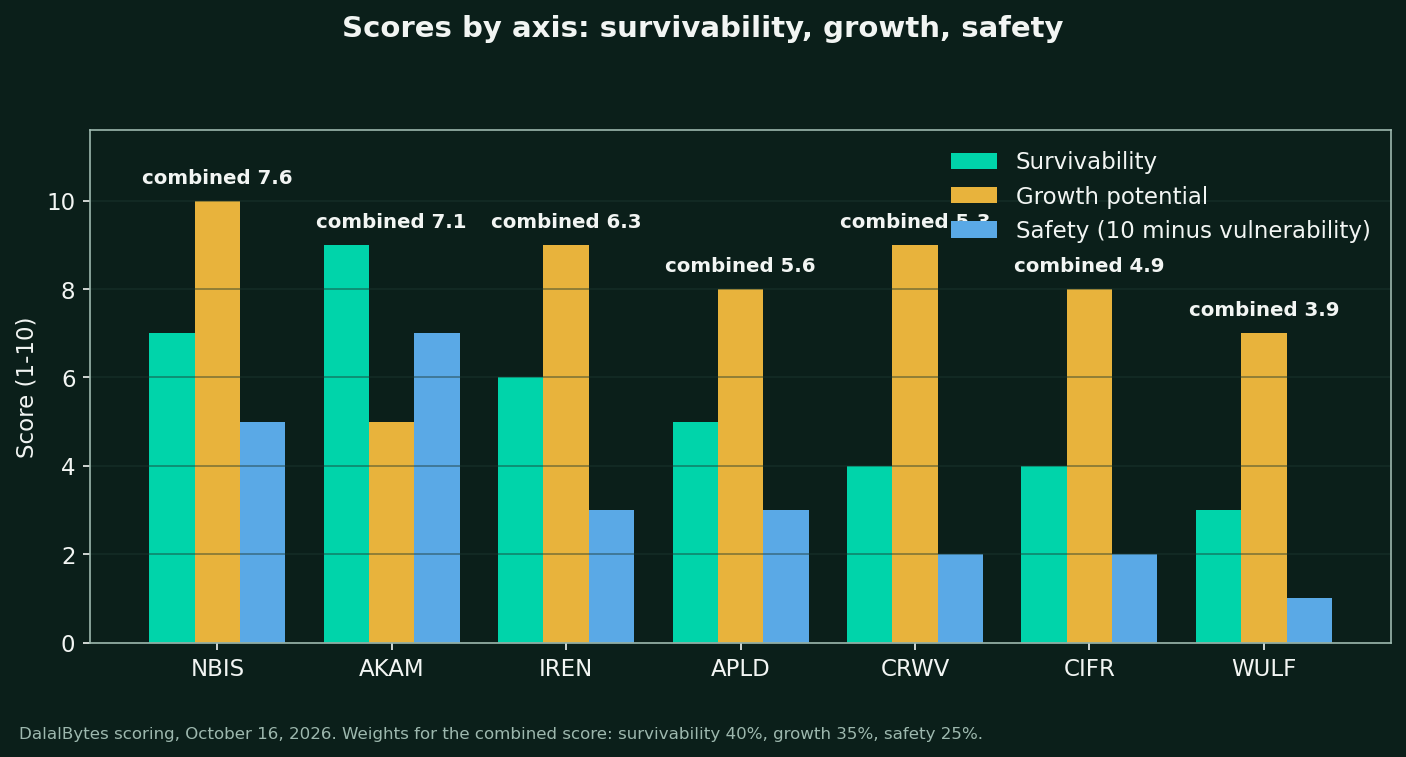
This is a quality ranking, not a return forecast. The distinction matters twice in this list.
TeraWulf ranks last on structure and was still our Selective Positive on October 15, because its price had already paid for the structure. CoreWeave ranks fifth despite the largest backlog in the group, because the credit market is pricing its capital structure honestly.
Change the weights and the middle shuffles. The top two and the bottom one do not move.
Who are the seven?
Three species sell into the same shortage. Two GPU cloud operators (CoreWeave, Nebius) rent compute by the hour and carry GPU fleets on their own balance sheets. Three landlords (Applied Digital, Cipher, TeraWulf) sell powered buildings on 10 to 25-year leases. IREN is migrating from bitcoin mining to the operator model. Akamai is an incumbent cloud and security company buying its way in with one very large capacity deal.
| Oct 15, 2026 | CRWV | NBIS | IREN | AKAM | WULF | CIFR | APLD |
|---|---|---|---|---|---|---|---|
| Price | $69.69 | $188.41 | $30.39 | $92.32 | $12.62 | $10.04 | $20.39 |
| Market cap | ~$38.4B | ~$47.7B | ~$12.0B | ~$13.3B | ~$6.3B | ~$4.2B | ~$6.2B |
| 52-week range | 60.55-150.40 | 73.52-299.86 | 28.93-76.87 | 70.82-165.45 | 10.47-29.84 | 8.79-30.14 | 18.36-50.72 |
| Anchor customers | Microsoft, OpenAI, Meta | Microsoft, Meta | Microsoft, NVIDIA | Thousands; Anthropic new | Anthropic, Fluidstack | AWS, Fluidstack | CoreWeave; one IG hyperscaler |
| Short interest (float) | ~16% | ~18% | ~22% | Low | ~28% | ~22% | High |
How do revenues and cash flows compare?
CoreWeave is the revenue king: fiscal 2025 revenue $5.13B, Q2 2026 $2.58B (+112% YoY), fiscal 2026 guided to $12.4-13.2B.
Nebius has the steepest slope: Q2 2026 revenue $582M (+454% YoY), ARR from $1.9B in March to $3.0B in June, guided to $7-9B by year-end.
Akamai has the largest durable base and the slowest growth: $4.21B in fiscal 2025, +5-6% in 2026, with Security +10%, cloud infrastructure (CIS) +39%, and Delivery -6%.
The landlords still report rounding errors against their contracts. Applied Digital booked $342M GAAP in fiscal Q1 2027 (+322%, mostly fit-out and hosting). IREN booked $707M in fiscal 2026, with AI cloud ($129M) passing mining for the first time. Cipher booked $60M of mining-only revenue in H1 2026. TeraWulf booked $45M in Q2 2026.
Cash flow separates the models more sharply than revenue does:
| Company | Operating cash flow | Free cash flow character |
|---|---|---|
| AKAM | FY2025 $1.52B | FCF about $1.0B in FY2025; the only self-funding engine here |
| NBIS | Q2 2026 $2.25B | Prepayment-driven; H1 capex $8.1B against $4.5B of OCF |
| IREN | FY2026 $2.10B | Mostly a $1.7B deferred-revenue build in one quarter; ex-prepayment Q4 OCF about $89M |
| CRWV | Q1 2026 $2.98B | Q2 2026 FCF about -$5.7B; capex guide raised to $35-39B |
| APLD | Q1 FY27 +$64M | Capex of $2.07B in the same quarter |
| CIFR | Q2 2026 -$244M | Negative in 7 of the last 8 quarters |
| WULF | FY2025 -$123M | Negative through the build-out |
Prepayments are a genuinely better funding model than debt. They are also a promise: when prepayments slow, the capex commitments they funded do not slow with them.
What do the debt stacks say?
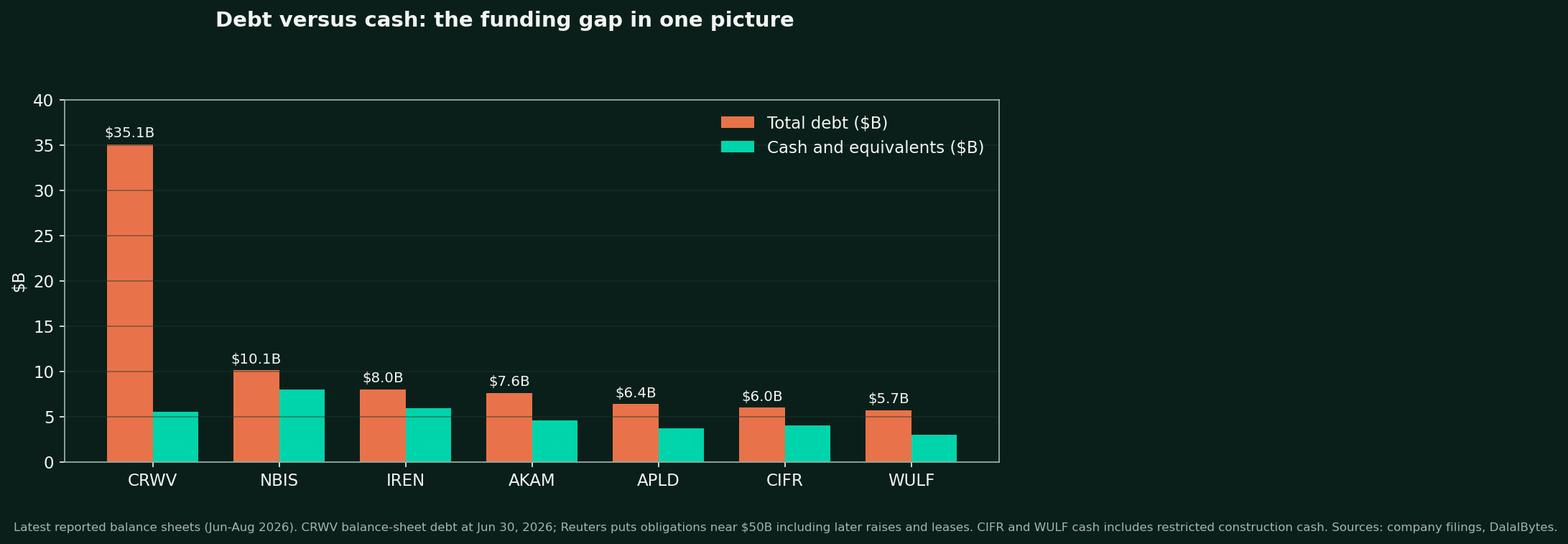
| Company | Total debt | Cash | Safety note |
|---|---|---|---|
| NBIS | $10.1B | $8.0B | Net debt ~$2.0B, below one year of guided revenue |
| IREN | $8.0B principal | $5.9B ($7.6B w/ restricted) | Investment-grade GPU financing near 6% for Microsoft; converts underlie up to 166M shares |
| AKAM | $7.6B converts | $4.6B | Net ~$3.0B; the only investment-grade balance sheet (Baa2 / BBB, negative outlook) |
| APLD | $6.4B | $3.7B incl. restricted | Project debt termed to 2031+; about $13B of further funding needed (JPMorgan estimate) |
| CIFR | $6.0B principal | $0.8B + $3.2B restricted | Equity $562M; company net debt ~$1.5B when restricted cash is netted |
| WULF | $5.7B face | ~$3.0B incl. restricted | Book equity $147M; a ~$3.5B raise still ahead |
| CRWV | $35.1B balance sheet | $5.5B | Equity ~$5.0B; bonds at 13-15% yields; CDS ~1,000bp; rated B+ / BB- |
How does the technology actually differ?
| Company | Platform | Scale now | Technical differentiator |
|---|---|---|---|
| CRWV | GPU cloud operator | 1.5 GW active, ~4.2 GW contracted; 250,000+ GPUs, 51 data centers | GB200 and GB300 NVL72 at scale; Vera Rubin NVL72 in production from Sep 2026; SUNK, Kubernetes service, Mission Control; Weights & Biases; ClusterMAX Platinum three straight times |
| NBIS | Full-stack GPU cloud | ~220 MW end-2025, guided 800 MW-1 GW end-2026 | Own data centers and cloud platform; Token Factory inference; NVIDIA design partner (9.3% holder); 41% adjusted EBITDA margin at small scale |
| IREN | AI cloud, ex-miner | ~40 MW AI live (Jun 2026); 0.3 GW targeted in 2026; 750 MW Childress campus, 2 GW Sweetwater | NVIDIA DSX AI-factory reference design toward 5 GW; ~150,000 GPU target; vertically integrated power and sites |
| AKAM | Distributed edge cloud | 4,300+ points of presence, 130+ countries | CPU-first inference at the edge plus GPU expansion; Guardicore segmentation and API security monetize the defense side of the same build-out |
| APLD | Developer-landlord | 250 MW live at Polaris Forge 1; 1.41 GW leased | Liquid-cooled, high-density campus design; ChronoScale GPU-cloud arm (GB300 NVL72, liquid-cooled) |
| CIFR | Landlord (ERCOT) | 907 MW operating plus contracted | Air and liquid cooling at Black Pearl; ERCOT interconnection queue positions; up to 2.5 GW of behind-the-meter gas in development |
| WULF | Landlord | ~102 MW earning rent; ~336 MW under construction | Liquid-cooled colocation buildings; ~93% zero-carbon power mix (company figure); demand-response grid flexibility |
CoreWeave's technology risk is accounting, not capability. The fleet is depreciated over about 6 years while critics argue the economic life is 2-3. Q2 2026 depreciation of $1.39B already runs at 54% of revenue. If the critics are right, reported margins overstate economic margins across every operator using long lives; CoreWeave is simply the largest case.
The landlords' technology is power engineering. Liquid cooling density, interconnection queue position, and delivery speed decide who gets the next lease. In a shortage, interconnection rights are the technology.
Akamai is the only one selling the other side of the trade. Every GPU cluster the others build expands the attack surface its security products defend, and its Anthropic deal rents CPU capacity at the edge rather than GPU capacity in a mega-campus. Different physics, different risk.
What does the deal ledger show?
First, the operators and the incumbent:
| Company | Counterparty | Scale | Term | Value | Credit support and status |
|---|---|---|---|---|---|
| CRWV | Microsoft | Core GPU capacity | Multi-year | ~67% of FY2025 revenue | Anchor tenant; concentration is the story |
| CRWV | OpenAI | Capacity tranches | Through 2029-31 | ~$22.4B total (11.9 + 4.0 + 6.5) | Includes a $350M OpenAI equity stake in CRWV |
| CRWV | Meta | Capacity | To Dec 2031; expansion to 2032 | $14.2B + $21B expansion (Apr 2026) | Signed; expanding |
| CRWV | Anthropic | Capacity | Multi-year (Apr 2026) | Undisclosed | Signed |
| CRWV | NVIDIA | Unsold capacity purchase | Through 2032 | $6.3B backstop | Plus a further $2B NVIDIA equity investment (Q1 2026) |
| NBIS | Microsoft | ~300 MW, Vineland NJ | Through 2031 | ~$17.4B (to ~$19.4B with services) | All contracted tranches delivered (Oct 2026) |
| NBIS | Meta | Dedicated capacity | 5 years; #2 from early 2027 | ~$3B + $12B, plus up to $15B contingent | Two deals (Nov 2025, Mar 2026) |
| NBIS | NVIDIA | Strategic investment | n/a | $2B equity plus warrants | NVIDIA holds 9.3% (13G, Jul 2026) |
| IREN | Microsoft | 200 MW (Horizon 1-4), GB300 | 5-yr average, through 2031 | ~$9.7B | 20% prepay per tranche; Horizon 1 accepted, 3-4 due Q4 2026; termination rights on missed dates; $3.6B IG GPU financing at ~6% |
| IREN | NVIDIA | ~60 MW cloud + DSX partnership | 5 years; partnership to 5 GW | ~$3.4B cloud deal | Plus NVIDIA's right to buy 30M shares at $70 |
| IREN | Frontier AI lab (unnamed) | AI cloud | Multi-year (Aug 2026) | Undisclosed | Reported to be Anthropic (The Information); unconfirmed |
| AKAM | Anthropic | Dedicated CPU capacity (Project Plans 2-3) | 7 years | ~$11.6B, plus up to $9B expansion | Delivery and SLA conditional; revenue H2 2027 to a ~$1.7B pace by end-2028; warrant for ~7.74M shares (~5%) at $111.33, vesting in tranches |
| AKAM | US technology company | Robotics development capacity | 4 years | Over $600M | Inside $2.8B+ of CIS commitments signed year-to-date through Q2 2026 |
Then the landlords, where the lease is the product:
| Company | Counterparty | Scale | Term | Value | Credit support and status |
|---|---|---|---|---|---|
| APLD | CoreWeave (Polaris Forge 1) | 400 MW, Ellendale ND | 15-year leases | Part of ~$36B base total | 250 MW live; Building 2 Phase 2 delivered Oct 1, 2026; Building 3 building |
| APLD | IG hyperscaler, unnamed | PF2, PF3, Delta Forge 1 and 2 (DF2: 210 MW) | 15 years (DF2) | DF2 ~$5.2B (Jun 2026) | Same tenant at four campuses; still unnamed at Oct 7, 2026 |
| CIFR | Fluidstack (Barber Lake) | 207 MW critical | Extended to 20 years (Sep 2026) | Over $9B at the site | Google backstop $1.73B; Google warrants 24.18M shares at $0.01; rent phases Q4 2026-Q1 2027; CIFR absorbs $359.3M of first-loss overruns |
| CIFR | AI lab, unnamed | Barber Lake, second term | 10 years after the Fluidstack term | ~$5.2B incremental | Binding commitment on substantially consistent economics (Sep 2026) |
| CIFR | AWS (Black Pearl) | ~300 MW | 15 years | ~$5.5B | Direct lease with AWS; rent commenced Aug 2026, two months early |
| CIFR | IG hyperscaler, unnamed (Stingray) | Third campus | 15 years | Undisclosed | Financed by $810M Stingray Compute notes at 6.000% |
| WULF | Anthropic (Justified, KY) | ~401 MW | 20 years, two 5-yr extensions | ~$19B (to ~$33B with extensions) | Direct lease; credit supporter unnamed; delivery H2 2027 to early 2028 |
| WULF | Fluidstack (Lake Mariner) | ~360 MW (CB-3/4/5) | 10 years | ~$6.7B initial (~$16B with extensions) | Google backstop ~$3.2B via recognition agreements; Google warrants 73.58M shares at $0.01 |
| WULF | Core42 (Lake Mariner) | ~60-72.5 MW | 10 years + renewals | ~$1.1B (~$2.5B with extensions) | G42 guaranty; $90M prepaid rent; fully commenced by Mar 2026 |
Read the credit-support column, not the value column. The deals with named, rated money behind them (Microsoft prepayments, AWS direct, Google backstops, G42 guaranty) behave like financing. The deals with unnamed support behave like hope, and the market prices them accordingly.
Whose moat is real?
NBIS: platform plus patron. NVIDIA equity, hyperscaler prepayments, and a full-stack cloud create switching costs. Real, but partly rented from NVIDIA's goodwill and allocation.
AKAM: the only compounding moat. A two-decade edge network, a security franchise growing double digits, thousands of diversified customers, and now an $11.6B Anthropic anchor. Slow, wide, durable.
IREN: power plus partnership. More than 5 GW of grid-secured pipeline and NVIDIA's DSX imprimatur. The mining moat ends by design, so this one must be re-earned in cloud operations.
CRWV: scale and software, negative financial moat. The best operator technology in the group, wrapped in the worst funding structure. It compounds only if capital stays available.
APLD: delivery reputation. Leased 1.41 GW across five campuses to two counterparties. One unnamed tenant deep at four of them.
CIFR: ERCOT positions plus the AWS proof. The pipeline is large (5.3 GW) and mostly uncontracted.
WULF: site scarcity plus structure invention. The Google recognition agreement was genuinely innovative and is now industry-standard, which is another way of saying the moat diffused.
How big are the pipelines against the companies?
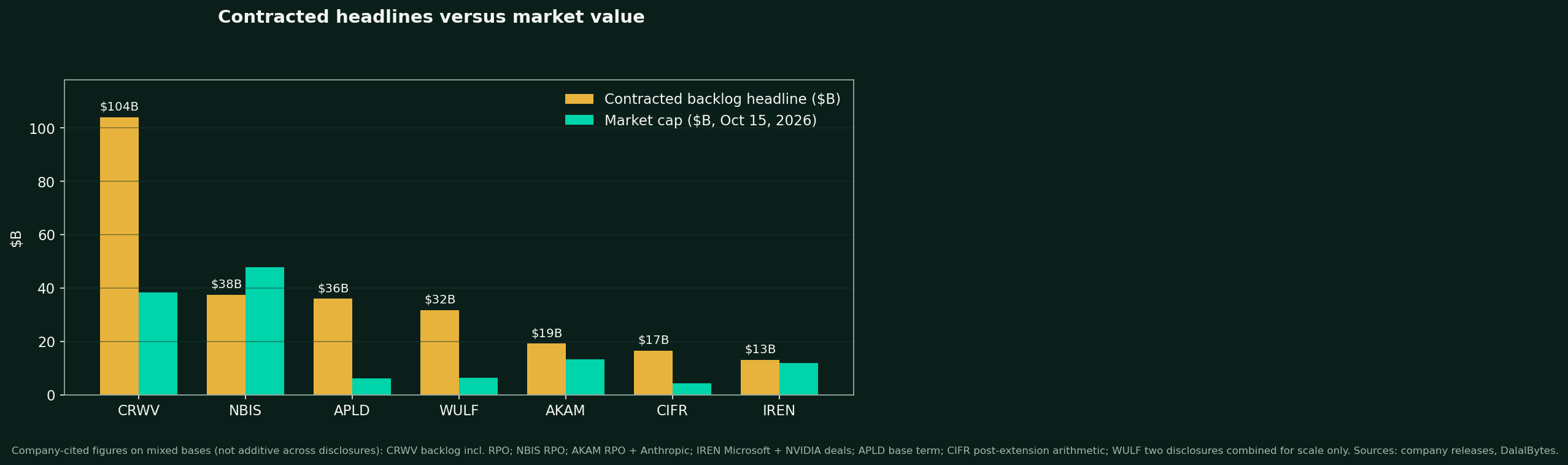
Nebius's pipeline is the most de-risked relative to its size: tranches delivered, prepayments covering 50-60% of deal capex, paybacks near 22 months.
CoreWeave's is the largest and the most concentrated: its top three customers plausibly exceed 85% of forward revenue.
Akamai's is the smallest relative to its revenue, and the only one that is upside rather than survival.
TeraWulf's and Cipher's convert to rent latest (2027-28 weighted), which is why their equities are the most violent in both directions.
Why these ranks, axis by axis?
Survivability: AKAM (9) > NBIS (7) > IREN (6) > APLD (5) > CRWV (4) and CIFR (4) > WULF (3).
Akamai funds itself and answers to thousands of customers. Nebius holds $8.0B of cash against ~$2.0B of net debt. IREN's cash is matched to contracted GPU financing, but it carries $13.8B of capital commitments and a $25-30B fiscal 2027 capex guide that assumes open markets. Applied Digital termed its debt out and still needs roughly $13B more. CoreWeave and Cipher carry credit-priced leverage on thin equity. TeraWulf has $147M of book equity and a $3.5B raise ahead of it.
Vulnerability: WULF (9) > CRWV (8) and CIFR (8) > APLD (7) and IREN (7) > NBIS (5) > AKAM (3).
TeraWulf concentrates about 48% of its contracted megawatts in one lease whose credit supporter is unnamed, inside a New York regulatory fight. CoreWeave is one Microsoft decision and one credit-market mood from a refinancing problem. Cipher is pre-revenue in HPC until Q4 2026 and absorbed $359.3M of construction overruns. Akamai can lose the entire Anthropic bet and remain a profitable incumbent; no one else here can say that about its anchor deal.
Growth: NBIS (10) > CRWV (9) and IREN (9) > APLD (8) and CIFR (8) > WULF (7) > AKAM (5).
Nebius pairs the steepest slope with the largest backlog relative to its size. CoreWeave's growth is real and bought at the highest cost of capital in the group. IREN's contracted ARR of $4B stands against $707M of fiscal 2026 revenue. Akamai grows slowest in percentage terms and adds the most absolute profit per point of growth.
What would change the ranks?
The calendar first: Nebius reports Q3 on October 22, 2026 (ARR against the $7-9B year-end guide). Cipher reports around November 2 (its first HPC revenue). Akamai on November 5 (CIS acceleration, Anthropic capex pace). TeraWulf on November 6 (rent commencements, financing signals). CoreWeave on November 9-10 (backlog conversion, credit commentary).
Then the structural triggers:
Naming the Anthropic credit support behind the TeraWulf lease (and confirming the Cipher lab) upgrades both landlords.
A CoreWeave refinancing at single-digit yields upgrades it two places. A punitive one confirms the CDS.
Microsoft accepting IREN's Horizons 3-4 in Q4 2026 settles its delivery question.
Applied Digital naming its hyperscaler removes its largest valuation discount.
Nebius holding prepayments above 50% of new-deal capex keeps its funding model, and its rank, intact.
Download the detailed comparison (PDF)
Frequently asked questions
Which AI infrastructure stock is safest?
Akamai, and it is not close. It is the only self-funding, diversified, investment-grade name in the group: $4.2B of revenue, about $1.0B of free cash flow in fiscal 2025, thousands of customers, and an AI capacity deal ($11.6B with Anthropic) that is upside rather than survival. It ranks first on survivability (9/10) and last on vulnerability (3/10). It also grows slowest, which is why it ranks second overall behind Nebius rather than first.
Why does CoreWeave rank only fifth despite a $104B backlog?
Because the ranking prices the funding, not the backlog. CoreWeave carries about $35B of balance-sheet debt (Reuters puts obligations near $50B including later raises and leases) against roughly $5B of equity; interest runs near 25% of revenue; its unsecured bonds yield 13-15% and its CDS near 1,000bp implies a roughly 63% five-year default probability (LSEG via Reuters, October 15, 2026). Its bulls (average target $137-141 versus a $69.69 close) are pricing 2027 capacity scarcity, and they may be right, but on survivability and vulnerability the structure ranks where the creditors put it.
Why does TeraWulf rank last here but get a Selective Positive in its own report?
Different questions. The ranking grades structure: $5.7B of debt on $147M of book equity, an Anthropic lease whose credit supporter is unnamed, and a $3.5B raise still ahead make WULF the most vulnerable balance sheet in the group. The report grades price: after a 61% drawdown, the equity trades near replacement cost for its contracted megawatts and below Morgan Stanley's bear case. A fragile structure can be a good trade at the right price; this ranking deliberately does not confuse the two.
Disclosures
Research and opinion, not investment advice. The author holds long positions in Nebius, IREN, and Akamai. The author holds no position in CoreWeave, TeraWulf, Cipher Digital, or Applied Digital at publication. Positions may change without notice. Figures are drawn from public filings and reporting believed reliable but not guaranteed; verify before acting. DalalBytes research on individual names in this comparison: Nebius, Akamai, Applied Digital, TeraWulf.
© 2026 DalalBytes Research · For educational purposes only. Not investment advice.